The 2009 Toronto Film Festival is upon us and, truth be told, it can be a little overwhelming. Will we see the next Oscar winner (or at least nominee like last year's Best Foreign Film nominee Waltz With Bashir)?
Will we run into a celebrity again (over the years, Harrison Ford, Ben Kingsley, Michael Moore, Bob Hoskins, Cher and Roger Ebert)?
What country's films will we fall in love with (Thailand) and which one will leave me cold (Iran)?
The thing is you just don't really know what kind of festival you are going to have until its done. We've been attending TIFF for 11 years now and those don't even put a dent into the 271 feature films that are unspooling this year alone.
So every year we dive into the schedule and see what we can find. Of course after so many years, we have a few things I look for. The first are directors that we've discovered at the festival over the years. It looked thin on the ground this year, until we found Sawasdee Bangkok, three short films about Bangkok that have two directors whose films we loved in past years: Wisit Sasanatieng (Citizen Dog) and Pen-ek Ratanaruang (Last Life In The Universe). Score!
Next we look for new Canadian films. Living in Toronto you'd think we'd be exposed to Canadian movies, but no, so the festival is our best chance to see home-grown talent. This year we are seeing The Trotsky, about " a precocious Montreal teen who fervently believes himself to be the reincarnation of Russian revolutionary Leon Trotsky." It's a comedy — go figure.
We are also seeing Definitely Not The Opera host Sook-Yin Lee's Year of the Carnivore, which I'm hoping isn't super self-indulgent. We'll see.
For our Hollywood/celebrity quotient we are seeing The Men Who Stare At Goats. We usually avoid movies that are coming out in the next month or two but we aren't getting out to many movies these days (hello almost three-year-old!) and this looked like good fun. And hey, I'm not immune to the charms of seeing George Clooney in the flesh.
Lastly we are seeing La Soga, a film from the Dominican Republic about drug dealers and assassins. It's like The Wire, but in Santiago instead of Baltimore. Or maybe not. That's the thing, you just never know. But it is rare that we ever get a clunker, and surrounded by other film fans it is always a great experience.
From the brilliant remixers Eclectic Method comes a fabulous mashup tribute to John Hughes. Yes, I know he died two weeks ago, but this is far too cool.
And, in coming across this mix at Clandestine I further discovered that Eclectic Method will be headlining the closing party for the Toronto International Film Festival, playing on massive LED screens in Yonge-Dundas Square on September 19. Sweet! No further details, but I assume the show will be free as it is a public square.
Alright, stating to get excited for the festival, even if I'll only get to see five films this year.
In three days we went to Lebanon, Myanmar, Japan, South Africa and southern Ontario, saw two documentaries, two horrors, two films with animation at their heart and heard from the directors of each of them. It's why we will always have tickets for the Toronto International Film Festival.
First up was Waltz with Bashir, a documentary of one soldier trying to reconstruct his memories of Israel's 1982 incursion into Lebanon and the subsequent massacre at two refugee camps. It was unlike doc that I'd ever seen. Instead of putting his subjects in front of the camera, Ari Folman illustrated their uncertain recollections and nightmares. It played almost like a drama and laid bare the impact of war on those whose job is to just follow orders, a phrase Jewish people have heard before.
Unfortunately our other documentary, Sea Point Days, failed where Bashir succeeded. Director François Verster also tried to tell his story of a formerly segregated beach front in Cape Town, South Africa without the usual talking heads. In place of commentary he showed endless shots of the people playing in the pools, walking on the beach, random birds... and on and on. There was an interesting story about the changes that are still taking place in South Africa, but it was buried in over an hour plus of pointless footage.
It was a mixed reaction for Vinyan, a film that began looking at the desperation of a couple searching for any sign there son may be alive following the 2004 tsunami, but midway through became a horror film populated by entrail-eating, feral children. We were with them for awhile, but once they started stumbling through the jungle our interest in their plight had diminished so much that the madness that followed had little impact.
Into that oh-so-happy mix came Detroit Metal City, blazing with with enough cartoonish metal mayhem to lighten up those darkened theatres. Currently sitting in the Top 5 at the Japanese box office after four weeks, DMC follows the hopes and dreams of a timid, geeky J-pop wannabe who instead finds himself fronting for a notorious death metal band whose fans think he is a demon from Hell. It's goofy and sweet and yet still goes heavy with the axe work (Gene Simmons plays death-metal king Jack IL Dark). It has a touch of Amélie and the show Reaper. Light-hearted, fun and so very Japanese.
Last, but far from least, stumbled the word-infected zombies of Pontypool, a wonderfully claustrophobic, psychological horror that I wrote about earlier. It was great fun but it was the moments leading up that made it a perfect festival experience. After 15 minutes past the start time, director Bruce McDonald came up to the front and started telling tall tales about he cost of filming and than spun out a tale about lead actor Stephen McHattie's hat being digitally inserted when he noticed a friend in the audience. "Oh, that mean's the film has arrived," said McDonald, explaining that they had just finished that day.
Funny stuff and just the kind of stuff that only happens at a film festival and I can't wait until next year, even if it is getting a little elitist.
Shut up or die, for your words may lead directly to your demise. That is the premise that lies at the heart of director Bruce McDonald's latest film Pontypool, about a small town that has been infected by a virus that is spread through language.
Set entirely inside an AM radio station located in the bowels of an old church, the evidence of a growing madness comes through radio reports and eyewitness accounts of townspeople speaking gibberish and tearing people limb from limb, as a washed-up shock jock and his producers try and make sense of it all. For what is often described as a zombie movie, there is little in the way of the gore, or the undead for that matter. The horror comes from the growing tension as events outside the station spiral out of control and begin closing in.
What is causing everyone to act so strangely? Is it words? Only English words? Or is it the meaning of the words and why here and why now? The answer is not provided, but not by oversight. The answer isn't available in the novel that it is based on either, Pontypool Changes Everything, and that's the way author Tony Burgess likes it.
I had the opportunity to interview Burgess nine years ago about the last book in his Bwedley trilogy, which explored the dark underbelly of small towns, where violence, fear and dark secrets blossom and thrive. "It's not necessary for everything to be explained," he said at the time, "as long as the emotion or the context is understood."
So is Pontypool about the power words have over us? That wielded in a skillful way can lead people to evil and violence? "There is a thing the metaphors mean, but that thing might be very personal to me, and may not necessarily contribute to the reading," he said of his ideas. Seems he hasn't changed either. "Working with Bruce (McDonald) has been great," Burgess told CanCult this month, "I write him these insane things that I think he’ll fire me over, but he just keeps putting them in the damn movie."
Here is McDonald (standing beside Burgess) at our screening this weekend. Sorry about the image quality, the camera doesn't do so hot without proper lighting.
If you're planning to attend the Toronto International Film Festival, you've got to want it. Since early July we've made one phone call, waited in three long lines and spent two nights pouring over detailed film schedules — all just to get tickets. Some may describe TIFF as the "people's festival, because of the relative ease for the public to get tickets," but don't let anyone tell you it's easy.
When I describe the process to people they often stop me part way through, already deciding to give it a pass, which is a shame as it really is worth the effort. Gill and I have seen more than 100 films at the festival over the years and only but a handful have left us disappointed, such is the depth of the talent that unspools in the darkened theatres across the city every September.
This year our festival will be short and sweet — five films in three days — due to the logistical wrinkle called baby-sitting. But despite having a limited window to choose from, I'm pleased with our results, even with a poor showing in the ticket-box raffle. Our five flicks are:
Waltz with Bashir: an animated documentary from Israel about an attack on a refugee camp in Lebanon Vinyan: a couple searches, perhaps hopelessly, for their son following the Indian Ocean tsunami of 2004 Detroit Metal City: A Japanese music geek unwittingly becomes the front man for a death metal band Sea Point Days: Another documentary about a beach area in post-apartheid Cape Town Pontypool: Bruce McDonald's take on Tony Burgess' cottage-country gothic zombie tale. Wrap your head around that.
We will also miss a few, of course. We had really wanted to see O'Horten, from Norwegian director Brent Hamer, as we'd seen his earlier film Kitchen Stories in 2003, but it was already sold out by the time our picks were processed. Who knew Norwegian films had such a following? Sadly, it may mean we'll never get to see it as it's hardly the kind of film that makes it to screens any other time of the year. One of the joys and curses of the festival.
We also wanted to catch Quebec director Philippe Falardeau's movie C'est pas moi, je le jure! (It's Not Me, I Swear!) but both screening were booked solid. We've become fans after seeing his last two festival entries, La Moitié gauche du frigo and Congorama, and it appears others have as well. At least that one may make it to theatres, so there is still hope.
And to me, that's what the festival is all about: discovering new talent and seeing films that rarely make it out of the festival circuit. Meanwhile the vast majority of coverage the festival gets is about who will walk the red carpets, will Angelina join Brad at the premiere and what party will they attend afterwards? It is wall-to-wall celebrity worship, right down to a list of freebies these already wealthy people will get while cocooned in luxury, briefly appearing before the start of their films, at a press conference, a few interviews and a party before jetting off.
There really are two festivals in Toronto, the Hollywood sideshow which has come to dominate the press and public's imagination, and the rest of the films. There are 312 features and short films this year and the vast majority have little star wattage. But that's where you'll find me, at my own private festival.
What would New Year’s be without me adding to the plethora of lists? So without further ado, here is my picks for the best in pop culture for 2006, in no particular order:
Heroes The most sci-fi show on network television since The X-Files is also the best show on TV this year, topping Prison Break and even Lost. Random people suddenly develop powers and must figure out how to handle and use them, for better or worse. It is the best comic-inspired work of fiction since Sin City, doling out plot developments at a furious pace.
Hiro Nakamura Super Hiro is the heart and soul of Heroes and the one character who wholeheartedly embraces his newfound powers and sets out to do good with them. Also, as a Star Trek quoting Japanese nerd, he provides the show with comic relief.
Truthiness Stephen Colbert was on a tear this year: he lambasted George Bush and the assembled media as a speaker at White House Correspondents' Association Dinner; he had his fans stuff the online ballot box to have a Hungarian bridge named after him; and the Merriam-Webster dictionary selected truthiness as its Word of the Year for 2006. The Colbert Report is spectacular satire.
OK Go I’d never heard of these guys until the day I got sent a link to a video for a catchy song – Here It Goes Again – and their treadmill-hoping, choreographic perfection. Then I watched it over and over and over again.
Royale With Cheese After the unceremonious dumping of Pierce Brosnan as the agent with the licence to kill and years of speculation on who would fill the tux, Daniel Craig emerged as the new, hard-edged 007, reinvigorating the venerable franchise without abandoning its past.
Parkour The most thrilling movie chase of the year had no gadgets and no cars, just two people making their way though a construction site at a death-defying, breakneck speed. The opening sequence of Casino Royale showed a terrorist using the technique, also known as free running, to escape the pursuing James Bond. Pure adrenaline.
Sloan After 15 years, the Canadian power pop quartet refuses to phone it in, releasing the 30-song Never Hear the End of It and heading back out on tour. Much goodness to be had.
Toronto During TIFF Visitors often complain that Torontonians are cold and aloof – and they aren’t wrong – but all of that changes during the Toronto Film Festival. Suddenly complete strangers are chatting with each other with ease while in lines and theatres. They compare notes, thoughts on films, celebs they’ve spotted and then as quickly as it began, it evaporates. I wish the city were like this year-round.
The Tick vs. Season One The big blue bug of justice finally comes to DVD after 12 years and multiple fan requests. A parody of superheroes, The Tick is as dim as he is strong – neigh well invincible – as he battles bizarre villains alongside an equally bizarre cast of characters, including American Maid, Die Fledermaus and the Civic-Minded Five. I’m so thrilled, all I can say is spooooon!
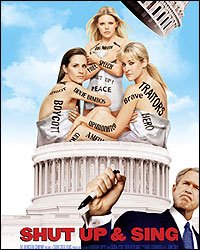
Shut Up and Sing I’m no Dixie Chicks fan, but the documentary on what the country stars went through after lead sing Natalie Maines said “Just so you know, we're ashamed the President of the United States is from Texas,” was a real eye-opener. Their statement is mild by today’s standards though it was almost a career killer a scant three years ago. I picked Fido as my top movie of the Toronto Film Festival, but months later, it’s the Chicks that I keep talking about.
S.O.A.P. Suds Despite massive amounts of internet hype, Snakes on a Plane is grounded. Turns out all the bloggers saying “wouldn’t it be cool if they did…” never had any intention of going to see it. Best web hoax of the year!
Video Mashups It was like the birth of a new art form as digital videos, YouTube and people with loads of free time collided to create some of the most hilarious web moments of the year, from Toy Story 2 recast in the Requiem for a Dream trailer to the Peanuts gang shakin’ like a Polaroid picture to Outkast’s Hey Ya. Absolute brilliance.
Britney Spears While there are many pretenders to her throne, Spears is in a class of her own when it comes to young celebrity train wrecks. From questionable parenting (now where did I put Sean Preston?) to finally dumping her parasite impregnator Kevin Federline, and then partying harder than Paris Hilton in a one-week period, she bows down to none. Keep trying Lindsay and Nicole.
Not Ready for Prime Time Players Saturday Night Live is hot this year, not so much the show, but the shows about the show. Studio 60 on the Sunset Strip gives West Wing fans a taste of what they’re missing (even if it does take comedy writing far to seriously) and 30 Rock has all the laughs, especially with the sublime Alec Bladwin playing network blowhard Jack Donaghy. As for SNL itself, on the rare occasions it has a funny skit, I can watch it the next day on YouTube – see Lazy Sunday and Dick in a Box.
Yul & Ozzie The top two finalists in Survivor: Cook Islands actually deserved to be there: Yul for his masterful playing of the game and controlling other contestants without it ever being obvious and Ozzie for being one of the most natural physical players ever to compete. The reality show granddaddy proved it still has chops.
For more lists than you can possibly imagine, be sure to check out Fimoculous' stunning list of lists, including such gems as the Best Re-cut Movie Trailers, the Top 10 Retro Gadgets, the Top 10 Sex Toys, the Top 5 Most Pretentious Looks and more music and film Top 10s than you will ever be able to read.
Have you seen any Canadian films lately? It’s likely that you haven’t, because they aren’t that easy to get to. The Toronto Film Festival Group released its list of the Top 10 Canadian films of 2006 this week and most of them haven’t been seen outside of the festival circuit. I would say it is only because I am an avid TIFF attendee that I've seen any homegrown films this year.
Here is the Top 10, celebrating the best of Canuck cinema:
Away From Her – Sarah Polley
Congorama – Philippe Falardeau
The Journals of Knud Rasmussen – Zacharias Kunuk and Norman Cohn
Manufactured Landscapes – Jennifer Baichwal
Monkey Warfare – Reginald Harkema
Radiant City – Gary Burns and Jim Brown
Sharkwater – Rob Stewart
Sur La Trace D'Igor Rizzi – Noel Mitrani
Trailer Park Boys: The Movie – Mike Clattenburg
Un Dimanche a Kigali – Robert Favreau
Sharkwater was one of our festival faves, at has been cut by 90% since the 1950s. It, like many of the films on the list, has not been released yet, nor does it have a distributor. Even Sarah Polley’s film, Away From Her, won’t hit theatres until May.
I haven’t seen the Trailer Park Boys movie, which made the list, nor the top grossing Good Cop, Bon Cop, which did not. Neither of which had any appeal to me in the first place. So do I really have the right to tell people to go and see Canadian films? Perhaps not.
This year the festival didn’t separate the Canadian films in the program, placing them in the categories that were the most appropriate – allowing them to stand shoulder to shoulder with the best of world cinema. If we picked a Canadian film it was because it appealed to us – being homegrown was just an added bonus – which is how I think it should be done. But outside of the festivals, it can be difficult to find a screen with a Canadian film on it, or two even hear about them in a Hollywood dominated entertainment press.
If people don’t even have a chance to see the best of what comes out of this country – as evidenced by the TIFF list – than how will the industry even grow any larger? Maybe it is time for some Cancon regulations for theatre distribution. It worked for the music industry.
Champagne corks must have been popping when U.S. theatre chains started banning Death of a President from their screens. The controversial film, which looks back at the future fictional assassination of George W. Bush in a faux documentary, has been shut out of three major chains – over 16,000 theatres.
There’s nothing like telling people you can’t see something to drum up interest in exactly that. This was not going to be a movie that people were going to flock to, so this kind of action will have two positive effects for the film. Firstly, it will generate heaps of free publicity as people write about the ban (guilty as charged) and secondly, it will concentrate the audience in fewer venues making it appear more popular, like a bar with a huge line outside. Controversy sells, and these chains are helping more than they think. The same goes for CNN and NPR, who both rejected ads for the movie this week, due to its content.
“That's a really striking statement,” said director Gabriel Range. “I think some of the theatre chains have decided that it's an opportunity for them to take a moral stance, and I find that questionable.” He’s right of course. The only reason that people shouldn’t go and see DOAP is that it isn’t a very good film. It has one provocative concept – the shooting of a sitting president – and has no other follow up. Range calls it “an engaging and compelling portrait of the post 9/11 world we live in." I call it a dull procedural that tells us less about the world we live in than any daily newscast.
Once Bush is shot, nothing too eye-opening happens. There is a rush to judgment that the assassin is Muslim (much like the Oklahoma bombing in ’95) and a naval battle group is set to Syria but told to stand down (unlike the post 9/11 invasions of Afghanistan and Iraq). As for the fascination over the mixing of current footage and actors, do the critics not recall Forrest Gump or ever seen an example from the current mashup phenomenon? Melding two disparate sources together to create a new work is nothing new.
It’s all about using controversy to push a product. The Toronto Film Festival got in on the act when DOAP was awarded the 15th annual Prize of the International Critics. Festival programmer Jesse Wente was on the CBC on Friday talking about the film and said the TIFF screenings were full, which of course they were as almost all screenings are full. I was at the premiere and it was in one of the smaller theatres at the Paramount. And the head of the critic’s panel said they awarded a film that "irritated us a lot," and “questions our conventions of making and seeing films." Not for it being a great film, mind you. Much like Cannes’ Palme d'Or often highlights edgy films, the Toronto film fest won’t be hurt any by consorting with contentious filmmakers.
Nothing sells like forbidden fruit of course, something Harvey Weinstein knows well. His company is distributing the other film that involves George W. Bush – the Dixie Chick’s Shut Up & Sing. NBC and the CW network have refused to air ads for the documentary about the reaction to Natalie Maines’ assertion that she was “ashamed the President of the United States is from Texas.” NBC said it could not accept the ads as "they are disparaging to the President."
Faster than you can say “free speech,” Weinstein had a press release in hand: "It's a sad commentary about the level of fear in our society that a movie about a group of courageous entertainers who were blacklisted for exercising their right of free speech is now itself being blacklisted by corporate America.” Of course this is the film people should see – an actual documentary about the “post 9/11 world we live in” and the sometimes negative effects of speaking out. This was a great film that also debuted at the Toronto film fest and unlike DOAP, actually has something to say. If you go and see one anti-George Bush film, go and see this one. Sex may sell, but so does controversy.
Fourteen films in 10 days – it’s over too soon and not done soon enough. The Toronto film festival is always a blur of excitement and always welcome at the end of the popcorn season. Every year we get to see films way before they are widely released and some that never again darken a theatre. It’s all part of the fun, as we often know little more than the description in the TIFF guide when we pick them. But by the time it is over, we’re ready to spend a little time on the couch watching the small screen.
I read that the few honours awarded by the festival are from panels with as few as three people on them, so I figure the Popped Culture Awards, with a panel of two is almost as legitimate. (The PCA’s have no monetary value and even less prestige and are ranked by our enjoyment of them and little else. And each film is awarded, so they are a lot like the Gemini Awards.) Check out everyone we saw over at my Flickr site.
Fido – Our first film of the fest and our fave. A zombie comedy, it was not typical film fest fare, but stuck with me long after. It may have a chance at commercial success.
The Fall – A wonderful adult fairytale and the most visually stunning piece we saw this year. Look for it in theatres.
Dixie Chicks: Shut Up and Sing – I wasn’t expecting much from this and it turned out to be a fascinating look at the hell the band went through for the heresy of saying war isn’t the best option.
Everything's Gone Green – Like Garden State set in Vancouver, but with more laughs and less melancholy. Plus it has a kick-ass indie Canadian soundtrack. This Is England – Another moving film by Shane Meadows as he mines his childhood for great stories.
Red Road – The last film we saw at the festival and I was impressed that the director was there on a Saturday morning. A Cannes winner, it follows a woman who works in the Glasgow closed circuit TV control room and spots a man she recognizes. How does she know him? What is she going to do? It has some truly uncomfortable moments as the story unfolds. “A real downer, you’ll love it,” said my friend James. He’s right.
Sharkwater – A passionate plea to save the shark population that has been cut by 90% since the 1950s. You’ll never eat shark fin soup again.
Citizen Duane – I didn’t see it as I was off blogging for the Schmooze Party so I missed it, but Gill said she had a good time.
Kabul Express – A political road movie, with more slapstick than insight, but fun nonetheless.
Congorama – An interesting take on nature versus nurture from a rising Quebec director. The province has a fantastic movie culture that we’re lucky to have.
Invisible Waves – A slowly paced, Thai yakuza film with little dialogue and less action. I’d hoped for more, but whatcha gonna do?
The Fountain – Darren Aronofsky’s follow up to Requiem For a Dream left me cold. It’s not a bad film when compared to most, but is pale when compared to his own work.
D.O.A.P. – This won the TIFF critic’s prize and I have no idea how or why. All concept and no follow through, Death of a President had one interesting idea – the assassination of the sitting president – and had little follow up as to what the consequences were. A huge disappointment that is getting by solely on controversy. A Stone's Throw – A crusading photographer returns home to Nova Scotia to reconnect with his family as he is losing his eyesight. Far too long and painfully slow, it certainly puts the art film back into the festival.
Of course we had the problem with the no Q&As at the Elgin Theatre - and we're not done with that campaign. And the festival was getting a little harsh with fan photos inside the theatres. I had a staff member tell me to erase my pics of the director of D.O.A.P., though they were hardly consistent in applying it. I know there are piracy concerns, but if stop fans (and bloggers) it will only hurt the festival. Maybe they need to put up shots fron the Q&As up on a website for all to access. It's a thought. Anyway, a great festival – I can’t wait until next year.
In such a celebrity-obsessed culture, it’s actually a surprise to see a line of screaming fans and have no idea who they are calling for.
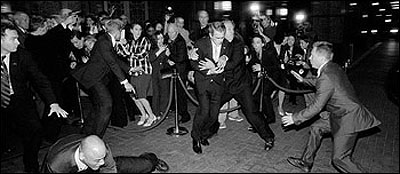
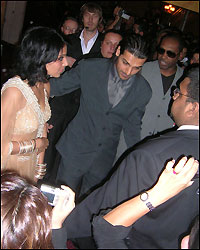
“Is there some big stars in this?” we asked a young girl standing in line, clutching an autograph book. “They’re big in India,” she answered. We had stumbled on to some Bollywood superstars in town for the premiere of Kabul Express, as John Abraham, Bipasha Basu and Arshad Warsi walked the Elgin’s red carpet, bringing some excitement to a usually dull end of the Toronto Film Festival. It was pandemonium. Girls were screaming and waving posters as a sea of camera flashes lit the length of the carpet. Theatre staff had to link arms to keep the crowd back, but another woman said if this has been India we wouldn’t have been able to get anywhere near them. Very entertaining.
The film itself was an odd mixture of road trip buddy movie and part political commentary on war and conflict. Kind of like Three Kings, but played more for laughs. Filmed entirely in Afghanistan (the crew was held at gunpoint during production) two Indian journalists are dropped, literally into Afghanistan just before the U.S. invasion, searching for an interview with the Taliban. They are promptly captured by a Talib, who forces them, their driver and an American photographer to take him to the Pakistani border.
They argue over who started the war, the best cricket players in the world and what’s better, Coke or Pepsi. "This is what the Americans do -- pump all the oil out of a country and fill it with Coke and Pepsi!" says the Talib, who is secretly part of the Pakistani military. Soon it becomes clear that political loyalties are paper-thin when it comes to war.
Pics: Top: John Abraham and Bipasha Basu walk the red carpet; Bottom: John Abraham and Arshad Warsi before the film
I know they can’t all be winners, but some of our Toronto film fest picks have been major letdowns. First up, The Fountain, the much anticipated film from director Darren Aronofsky – his first since Requiem For a Dream. I was hyped for this movie as his last two have had such an impact on me.
When we saw Requiem on a big screen I was sweating by the end, the images were so powerful. The quick-cut scenes of heroin use have since been copied by advertising and parodied in The Simpsons. And Pi made me feel like my head had been turned inside out – I thought and talked about the patterns in the numbers for days. It was a secular religious experience. So admittedly, The Fountain had a high bar to clear.
To my disappointment, Aronofsky limboed under it, barely breaking a sweat. The Fountain follows Hugh Jackman over three time periods and characters – a Spanish conquistador, a cutting-edge medical researcher and a 26th century astronaut (according to the synopsis, but I don’t agree) – all searching for immortality in some fashion. It’s a sprawling narrative, beautifully shot, but somehow cold and uninvolving. The tale of the doctor trying to save his wife from cancer had its emotional moments, but the so-called astronaut floating through space in a snow globe while communing with a dead tree and apparitions of his past lives added nothing. A lot of style, but unfortunately lacking an equal amount of substance.
As an aside, there was no Q&A after the screening, which took place at the Ryerson Theatre – in fact nobody from the film showed up, despite Aronofsky and stars Rachel Weisz and Ellen Burstyn being in town for it’s premiere at the Elgin. Last weekend TIFF programmer Jesse Wente said Q&As for films that debut at the Elgin, which doesn’t allow them, would happen at their second showing. It didn’t, so we still hate the Elgin.
Following The Fountain, we headed over to the Paramount for another anticipated film on our list, Invisible Waves. In 2003 we saw Thai director Pen-ek Ratanaruang’s Last Life In the Universe, a surreal tale of an obsessive-compulsive, suicidal Japanese man hiding out in Bangkok with a free-spirited Thai woman. It was quirky and fun and a favourite from that year. An almost existential black comedy about a low level gangster who isn’t aware that his days are numbered, it was too slowly paced, with too little action. No Q&A for this one either.
Again, not a bad film, but not what I had been hoping for. I suppose they can’t all be winners.
“Just so you know, we're ashamed the President of the United States is from Texas.” And with those words three years ago, Natalie Maines of the Dixie Chicks ignited a political and cultural firestorm. At the time the U.S. was on the brink of war in Iraq and George W. Bush was riding high in the polls, backed by a wave of patriotism. The media was cowed and critics who questioned the war rationale were shouted down with accusations of anti-Americanism.
Into this climate the Dixie Chicks were seen badmouthing the commander-in-chief to a foreign audience (they were in London). At home they faced a boycott of their music, country stations stopped playing them, people protested outside their shows and the band received death threats. Luckily, if I can use that word, a documentary crew was following the band during the whole ordeal.
We picked Dixie Chicks: Shut Up and Sing for our Toronto Film Fest mostly because Gill is a huge fan. Who am I to judge? I made her go and see zombies. Turns out it was a fascinating piece about the backlash they faced for daring to disagree with Bush. I understand the people have the right to choose what they want to listen to, but what happened to the Chicks went far beyond. The virulence directed at them was stunning.
That’s what bothers me the most. If you disagree with someone, that’s fine, but to insist that people aren’t allowed to have a differing opinion, to label them traitors, to call for them to be killed is insanity. I see that happening here in Canada too, as NDP leader Jack Layton is attacked for calling for a troop withdrawal from Afghanistan, not debated about whether or not it is a wise decision.
But enough of that rant. The film follows the chicks as the face the protests and decide to carry on anyway. Says Haines, “Now that we've fucked ourselves, I think we have a responsibility to continue to fuck ourselves.” Three years later they are back and while maybe not on top of the world they are unbowed.
It was like watching a Douglas Coupland novel come to life. Which was appropriate as Everything’s Gone Green, which played at the Toronto Film Festival on Tuesday, was written by Coupland himself.
If I had to guess, I’d say that Green was either a discarded chapter of his recent novel jPod (which just got named to the Giller prize long list) or an early draft. There were the parents running a marijuana grow-op in their suburban Vancouver basement; the brother involved in selling real estate to absentee Hong Kong millionaires; the late 20-something slacker working at a job he doesn’t care about who gets involved with an Asian gang. I finished jPod this summer and so the similarities are fresh in my mind.
And it works. Coupland tells great stories filled with quirky characters and a clear love for Vancouver, which was all perfectly captured by first-time feature director Paul Fox. I’m not the only one who thinks so. Coupland visited the set and told Fox, "That's freaky, it's like stepping into my own brain.” Seeing as nobody has yet to bring one of his novels to the big screen, this counts as a huge achievement.
It was fun and I hope people get a chance to see it for themselves. For those out west, it will open the Vancouver Film Festival soon and it has Canadian distribution, so it will be interesting to see if it can find an audience.
Pics: Above, a scene from Everything's Gone Green. Below, Paulo Costanzo at the Paramount screening.
One of my favourite parts of the Toronto film festival is you start to recognize directors as the return to the city every couple of years like long lost friends. Last night we were at the world premiere of Shane Meadow’s This Is England, a film about a young boy who falls under the influence of a charismatic skinhead during the early ‘80s.
For me, my festival experience and Meadows is intricately connected. The first year I lived in Toronto I was a TIFF volunteer and was working the door when a filmmaker a couple of years younger than me gave me his ticket and asked me where he was supposed to sit. That was my first introduction to Meadows, who was there with two shorts, Small Time and Where's the Money, Ronnie? He has since returned to Toronto every couple of years with realistically gritty films inspired by his rough and tumble upbringing in central England: Twenty Four Seven, A Room for Romeo Brass, Once Upon a Time in the Midlands and Dead Man's Shoes.
This Is England takes place during the Falklands War, when employment was high and Margaret Thatcher ruled with an iron fist. A young boy, who’s father has died in the conflict, is the constant target of local bullies and is befriended by a gang of skinheads. They are a genteel bunch who go swimming and party and appear more enamoured with the clothing and music of the movement than the politics. That is until an older member of the gang gets out of prison and starts preaching hate and violence. The comedic buddy film soon turns tense and explosive.
Meadows, who had just completed the film on Monday and was watching it for the first time with us, said he too had ran with skinheads when he was 11, but was essentially scared straight. "That night of violence is what turned me around," he told the audience. "That's probably the night the seed of a filmmaker was born.
On Monday we saw Philippe Falardeau’s Congorama, a Quebec director we have begun to follow. He was last at the festival with La Moitié gauche du frigo (The Left-Hand Side of the Fridge) which won the Best Canadian First Feature Film award back in 2000. It followed a Belgian man who, on discovering he was adopted, goes searching for his identity in rural Quebec and finds much more, but not necessarily what he was hoping for. It’s hard to explain without giving away some of the complexities.
Much of the tale wraps around moments from world fairs, one in Belgium and Quebec’s historic Expo ’67 and also appeared in last year’s festival fave, C.R.A.Z.Y. Neither director is old enough to have attended, so we asked him about it. He said the fair was so important to the province that it has become part of his own experience. “My parents went and took picture and films. When I look at these pictures now I feel like I’ve been there.”
Pics: Top: A scene from This Is England; Centre: This Is England director Shane Meadows; Bottom: Congorama director Philippe Falardeau
Two shots ring out and a president falls to the ground as people scream, cameras swirl and chaos breaks out. But it’s not just any president, it was U.S. President George W. Bush.
Controversial? Without question. Provacative? Surprisingly not. Death of a President (or D.O.A.P.) is a fictional documentary about the purported assassination of Bush in 2007 outside of a Chicago hotel and perhaps the most buzzed about film at this year's Toronto Film Festival. The most controversial part about D.O.A.P. is the fact it uses a current president as its assassination target instead of a fictional character. Beyond that it was nowhere near as edgy or political as the hype led you to believe.
After taking the bold step to use the current president as a target, the filmmakers appeared to lose their nerve to explore the worldwide ramifications of what would happen if the U.S. president was assassinated in the current world climate. D.O.A.P. focused more on detailing security failures and legal procedures than making a political statement. It was surprisingly passionless. Yes, it showed that the in a case like this the U.S. would jump to conclusions and make the evidence fit the facts. A Muslim was the top suspect and remained so even after an American comes forward with evidence his Dad, a veteran of the first Gulf War, did it. Any remember the Oklahoma bombing? After screening so close to the anniversary of 9/11 and being set in the future, it all seemed so five years ago.
D.O.A.P. really didn't tell us anything we don't already know and can't get in the current media, which has finally become more critical of George W. Bush, his decisions and his administration. You can find a more hard-hitting critique of the current regime from Jon Stewart in almost any episode the Daily Show.
There was a lot of controversy before this film screened, before anyone had seen it, which appears mostly unwarranted upon viewing. People need to stop freaking out about films they not watched themselves. The controversy continues with some reports describing the audience as cheering, others indicating everyone sat in stony silence. Neither are true – it was an attentive and receptive audience who gave the film the same applause any film gets after a screening. No more, no less. Any other reports are an example of the fact manipulation the film focuses on.
The deficiencies of D.O.A.P. became all the more apparent the next day when we saw Sharkwater, a documentary with little to no advance press. Now this was a film that had impact, both dramatic and emotional, telling a real story about how humans are killing off the world's sharks.
Rob Stewart, a photographer, set out to make a film about sharks and what beautiful creatures we were going to lose if we didn't stop killing them. He ended with a tale of political corruption and greed, and showing us that we may destroy ourselves in the process as we shortsightedly kill off the top of the food chain of the ocean.
Stewart showed how governments are allowing the overfishing of sharks in sensitive ecosystems such as Costa Rica and the Galapagos with wasteful methods such as long lining — all due to the demand in Asia, in particular, for shark fins. The fins are sliced off the sharks while they're still alive and then the bodies of the maimed fish are tossed back into the ocean to drown and bleed to death.
Unlike D.O.A.P., it had a purpose, a call to action. Despite having slaughtered 90% of the world’s shark population over the past 50 years – creatures that have existed for over 400 million years – Stewart said there was still a chance to make a difference before it’s too late. Visit Sharkwater.com for more details.
Pics: Above: A scene from Death of a President. Below: Gill and TBA pose with the Sharkwater mascot while I idiotically show what a shark will not do to you in the ocean.
The world premiere of The Fall would have been a fantastic opportunity for filmgoers to ask director Tarsem about how he managed to pull off this multi-country epic. But it was screened at the Visa Screening Room, a.k.a. the Elgin Theatre, which, for whatever misguided reason, refuses to allow questions and answer sessions after the films. So he waved at us before the film and told us to enjoy it.
One of the best aspects of attending the Toronto festival is not only the chance to see great films from around the world but to speak to directors and actors about the film you've just seen. Some of our best film fest memories have occurred in the moments after a movie as we ask the cast about how their creation came to be. We usually try to avoid the Elgin, but weren’t able to this year.
Other than Galas at Roy Thomson Hall, it appears that the Elgin is the only other film fest venue that doesn't do Q&As . Simply put, that policy tears the heart out of the film fest experience. Often the cast has flown in for the premiere of their film only to be allowed a cursory nod to the audience before being shuffled off stage. After The Fall, Tarsem and two of the main actors stood around to chat with appreciative fans in the few minutes before aggressive staff shuffled everyone towards the door.
We saw the dramatic Hotel Rwanda three years ago and hated the fact that Paul Rusesabagina, the heroic man the film was based on, was only able to acknowledge the standing ovation from a side balcony. That’s just cruel. Thankfully Michael Moore purposefully ignored the policy with Bowling for Columbine and held a great Q&A after his screening.
We’ve been pissed off about this policy for years but have done little other than grumble about it while in line for our next film. So this year we’ve decided to challenge it. We’ve already accosted two film fest directors this week to ask what was up. Noah Cowan, co-director of the festival, explained that while “we understand that interaction is integral to the festival experience, emptying the theatre is a logistical nightmare.”
Jesse Wente, part of the Canadian feature film selection committee, echoed the sentiment saying that getting 1,000 or more people out of the theatre was a “logistical nightmare” and suggested that instead of going to the Elgin, go to the second screening of any film (which would be at a different venue) that is shown at the Elgin first.
But is it really the logistics that are the problem? Ryerson Theatre seats upwards of 800 and there are Q&As there. Yes, it’s a lecture theatre, but it doesn’t seem to empty out much quicker. The Uptown (we lament its destruction but not its scrunched seating) was massive, seating close to 1,000 people and Q&As were held there too. Yes, the Elgin is more a performance theatre than movie theatre and might take longer to empty, but why does it have to ditch the most enjoyable part of the festival? Why not just leave more time in between films so questions can be asked? Or set one mike up front so people can ask questions, and if you’re in the balcony, well, sucks to be you. Line up earlier next time. Even limit it to 5 questions if need be, or have a film fest director ask a few obvious questions to the director — anything is better than nothing.
So, is anybody else annoyed by this policy? Should we call for a boycott of the Elgin? Write cranky letters? Tell Visa they’re wasting their money by sponsoring the theatre since its money doesn’t support the true film fest experience? The festival will only change if we demand it.
Look out Piers Handling, we’re looking for you next!
Imagine watching The Princess Bride, except almost everyone dies, the bad guy is a violent tyrant and the scenes are played out in some of the most stunning locales in the world. That is but a brief explanation of what watching The Fall is like, the latest film from Tarsem, the Indian-born director of the visually stunning, if disturbing, The Cell.
A sentimental tale of love and loss, The Fall is a story within a story. Roy, played by Lee Pace, is a depressed Hollywood stuntman bedridden and recuperating in hospital who befriends a five-year-old Romanian girl, newcomer Catinca Untaru, who broke her arm picking oranges at her family’s farm. He tells her a fantastic tale, set in the most beautiful locations around the globe, in return for her stealing him morphine from the dispensary.
She and Roy, his back broken after a fall during a daring movie stunt off a train bridge, have a strange symbiotic relationship. She gives him a reason to carry on as he wallows in his condition and the loss of his love who has deserted him. He gives the little girl some much needed companionship as she heals a broken arm and remembers the horrific things that have happened to her family – their house being burnt to the ground, her father being killed. But Roy abuses her trust by using his storytelling to convince her to steal drugs for him as his thoughts turn to suicide. It is a tale of tragedy of death and loss, and lost love disguised as a children's tale. And in the end, the experiences the pair share both hurt and save them.
The film, which made its world premiere at the Toronto Film Festival on Saturday, is a travelogue painted in an eye-popping rainbow palate, traversing from India to Bali, South Africa, Romania and too many others to mention. While the real world of the film, set in an austere hospital in Los Angeles has muted shades, the fairytale world is bathed in vibrant swaths of colour. Apparently it was filmed in 23 different countries and following the film Pace said he loved globetrotting for the role. That was the only chance we got to talk to the cast though, as the theatre staff hustled us out at breakneck speed. M0re on that later.
Hey Popped Culture fanatics, it’s the shadow behind Jeremy guest blogging here. Yep, his wife Gill. I’m no pop culture expert, but I’m learning, and I can call myself a film fest veteran since this is our 10th year attending. So as Jeremy blogged about schmoozing with the celebs, I saw Citizen Duane.
Director Michael Mabbott, who brought the faux rock star story The Life and Times of Guy Terrifico to Toronto’s film festival last year, came back this year with his second feature film Citizen Duane.
Mabbott says he sees some similarities between the characters of Guy Terrifico and Duane Balfour, the ambitious teen who is Citizen Duane.
“They’re both guys with good intentions,” he said after the film, but they both go about their goals in a bit of a twisted, warped way and manage to mess things up.
One of the writers (either Robert DeLeskie or Jonathan Sobol) says the story was inspired by his “odd political family from Niagara Region,” which might explain why it was shot in Hamilton, Ont.
Citizen Duane is a story about Duane Balfour, a dweeb of a high school student who is always trying to get one up on the popular, ruling class _ namely Chad, the high school president and the grandson of the town’s mayor, who’s now running for her sixth term in office.
Duane is like the human weeble, he gets himself punched and kicked around the block and regardless, he bounces back, no matter how hopeless the situation. It’s like that part of Duane’s brain that tells him he’s nuts and is just going to get smucked again is gone – or at least malfunctioning.
But Duane’s desire to fight the political machine is in his genes. Throughout the film there are hints that Duane is following in his father’s misguided footsteps, to the chagrin of his widowed mother, played by Alberta Watson.
After failing yet again to win the high school presidency away from his nemesis Chad, Duane decides to set his sights higher – as recommended by his favourite teacher, played by Vivica A. Fox – and run for mayor, trying to unseat the longtime incumbent, the matriarch of the Milton family.
Duane, played by Toronto-born actor Douglas Smith, does a fabulous job of wavering between a highly intelligent young adult and an idiotic teen. One moment he’s producing a documentary on the unending money and power of the domineering Milton family, raising the question about whether that’s the best thing for his hometown of Ridgeburg. The next moment, he charges across the school parking lot to jump on Chad, who is twice his size, after he loses the presidency; he accidentally sets fire to his girlfriend’s garage after his single gambling-addicted uncle tells him to make “a grand gesture” of his love for her (it included twirling fireworks); and nearly kills himself by barrelling down a hill on his suped-up bike – with all sorts of torture-type metal objects attached – to cause maximum damage to Chad’s SUV.
Duane’s ability to bounce back takes a beating though as the campaign mud gets slung and the well-known incident with Duane’s father gets brought up. In the end, the kid has learned a few things, that it’s hard to fight the fight, you aren’t likely to win, but still it’s worth it in the end. And you don’t always get the girl.
Star sighting: OK, I don’t know who the starlet was, but she was getting all dolled up in the dingy bathroom at Ryerson University just before the first screening of Borat on Thursday. She’d obviously just flown in to Toronto. Her small suitcase and Chanel dress were in a corner, a pair of stylish jeans and high-heeled brown suede boots were piled next to them. Her male makeup artist took up a corner of the bathroom and dressed up her face, slathering on the eye shadow and mascara, and fluffed her long tawny brown hair. She’d obviously shed her airplane clothes and jumped into something fresh, and she was wearing a slinky sleeveless silver top, tight blue jeans and strappy high-heeled sandals. Her manager or whatever kept coming in to grab her stuff and say “you look fantastic babe!”
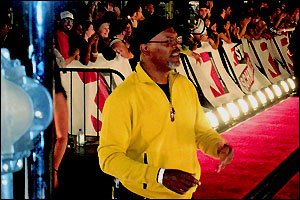
So Samuel L. Jackson and I were talking over beers last night about how he ended up acting with Christina Ricci in two upcoming films and how her career seems on the upswing. Oh wait, not really. I did stand about a foot away from Jackson and I had a beer in hand, but that’s as close as it got.
It turns out I don’t know how to schmooze. I was at the Star Festival Schmooze Party, blogging on behalf of Star (read my stream of consciousness blather), which gave my access all over the building. I wandered from the red carpet to the VIP room, but when I encountered celebs I tended to clam up and smile politely. Very Canadian of me.
After 10 years of Toronto Film Festival attendance, it was interesting to see how the other half parties. Quite honestly, I don’t know how people hit movies and parties all week and my guess is they don’t. I had to skip our Friday film to make this party, which is probably why they release so many reserved seats in theatres to the rush line. Cinema takes a backseat to an open bar.
There were a number of names at the party: Eugene Levy, Sarah Polley, Don McKellar, Billy Connolly, Shawn Ashmore, Chantal Kreviazuk, and the Canadian Idol judges among others. I heard Douglas Coupland was about but I didn’t see him. Anway once the red carpet wound up and my work was done I was able to meet up with some Dose friends, including their TIFF blogger Jen, and Command N podcast superstar Amber MacArthur. We then chatted with CBC radio host Jian Ghomeshi. Maybe I know how to schmooze after all.
What if the dead came back to life, but instead of being insatiable flesh-eating monsters they could do our menial chores, be our pets and even (gasp!) our friends and lovers? We’d all have to have one, wouldn’t we?
Such is the premise of Fido, a deadpan comedy, leaning more towards Lassie and Leave it To Beaver than Night of the Living Dead. It’s a fine addition to the growing zombedy genre and our first foray into the Toronto Film Festival this year. It is rare that we see a movie on the opening Thursday, but there were more screened than usual this year. Fido caught my eye as a funny concept about an idealized 1950s, where social conformity is paramount even when it comes to the living dead. I must not have been the only one as the TIFF programmers picked it as the opening night film for the Canada First series that focuses on new Canadian talent and ran it at the Ryerson Theatre, which I think is the largest venue in Toronto outside of Roy Thomson Hall.
It was a packed screening, with the ticket holder line snaking around a block and a half, but we got our usual seats about six rows away from the front (the only place my camera can even get a shot from and even then it’s all grainy and dark.). We saw a couple of friends while in line and again the city became friendly as it always does around this time, as we talked to strangers about what they were seeing. This definitely does not happen any other time of the year.
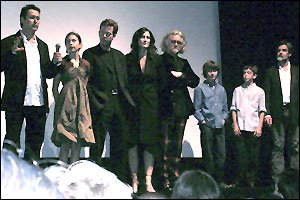
Turns out Fido also has quite a named cast. Billy Connolly plays the titular zombie; Carrie-Ann Moss (in the first film I’ve seen her in since the Matrix) is the mom; Tim Blake Nelson plays a former ZomCom employee, Henry Czerny as the head of ZomCon security and Dylan Baker as the father. I don’t know how an indie Canadian film landed such a cast and the Q&A wasn’t long enough to ask. Connolly, who only grunted and snarled throughout the film, was a foul-mouthed chatterbox afterward, proclaiming Fido “the weirdest fucking film I’ve ever been involved in.” The Sun has a good interview with him today.
Overheard: “I know, but it’s a school day tomorrow.” The 14-year-old star of the film, K'Sun Ray, who plays Fido’s master Timmy Robinson, being told he can’t go to the after party as he was being hustled into a waiting limo.
Fun Fact: Peter Stormare was lined up to play Fido, but had to drop out when he got the role of John Abruzzi on Prison Break,
Star Sighting: George Stroumboulopoulos jumping to the front of the line waiting for the premiere of Borat, which was screening right after Fido.
Good News/Bad News: First the bad – I have to skip our screening of Citizen Duane. I wanted to go as I enjoyed director Michael Mabbot’s Guy Terrifico last year. The good news is I’m skipping it to blog for the annual Star Schmooze Party, one of the biggest parties of the festival. Look for me on the red carpet – I’ll be the guy who looks like he shouldn’t be there.
 The 2009 Toronto Film Festival is upon us and, truth be told, it can be a little overwhelming. Will we see the next Oscar winner (or at least nominee like last year's Best Foreign Film nominee Waltz With Bashir)?