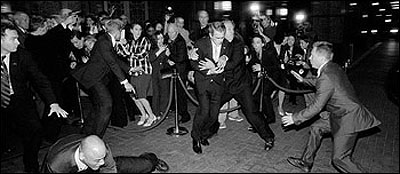
Champagne corks must have been popping when U.S. theatre chains started banning Death of a President from their screens. The controversial film, which looks back at the future fictional assassination of George W. Bush in a faux documentary, has been shut out of three major chains – over 16,000 theatres.
There’s nothing like telling people you can’t see something to drum up interest in exactly that. This was not going to be a movie that people were going to flock to, so this kind of action will have two positive effects for the film. Firstly, it will generate heaps of free publicity as people write about the ban (guilty as charged) and secondly, it will concentrate the audience in fewer venues making it appear more popular, like a bar with a huge line outside. Controversy sells, and these chains are helping more than they think. The same goes for CNN and NPR, who both rejected ads for the movie this week, due to its content.
“That's a really striking statement,” said director Gabriel Range. “I think some of the theatre chains have decided that it's an opportunity for them to take a moral stance, and I find that questionable.” He’s right of course. The only reason that people shouldn’t go and see DOAP is that it isn’t a very good film. It has one provocative concept – the shooting of a sitting president – and has no other follow up. Range calls it “an engaging and compelling portrait of the post 9/11 world we live in." I call it a dull procedural that tells us less about the world we live in than any daily newscast.
Once Bush is shot, nothing too eye-opening happens. There is a rush to judgment that the assassin is Muslim (much like the Oklahoma bombing in ’95) and a naval battle group is set to Syria but told to stand down (unlike the post 9/11 invasions of Afghanistan and Iraq). As for the fascination over the mixing of current footage and actors, do the critics not recall Forrest Gump or ever seen an example from the current mashup phenomenon? Melding two disparate sources together to create a new work is nothing new.
 It’s all about using controversy to push a product. The Toronto Film Festival got in on the act when DOAP was awarded the 15th annual Prize of the International Critics. Festival programmer Jesse Wente was on the CBC on Friday talking about the film and said the TIFF screenings were full, which of course they were as almost all screenings are full. I was at the premiere and it was in one of the smaller theatres at the Paramount. And the head of the critic’s panel said they awarded a film that "irritated us a lot," and “questions our conventions of making and seeing films." Not for it being a great film, mind you. Much like Cannes’ Palme d'Or often highlights edgy films, the Toronto film fest won’t be hurt any by consorting with contentious filmmakers.
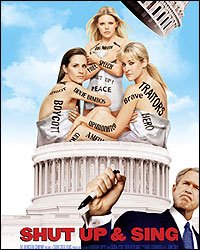
Nothing sells like forbidden fruit of course, something Harvey Weinstein knows well. His company is distributing the other film that involves George W. Bush – the Dixie Chick’s Shut Up & Sing. NBC and the CW network have refused to air ads for the documentary about the reaction to Natalie Maines’ assertion that she was “ashamed the President of the United States is from Texas.” NBC said it could not accept the ads as "they are disparaging to the President."
Faster than you can say “free speech,” Weinstein had a press release in hand: "It's a sad commentary about the level of fear in our society that a movie about a group of courageous entertainers who were blacklisted for exercising their right of free speech is now itself being blacklisted by corporate America.” Of course this is the film people should see – an actual documentary about the “post 9/11 world we live in” and the sometimes negative effects of speaking out. This was a great film that also debuted at the Toronto film fest and unlike DOAP, actually has something to say. If you go and see one anti-George Bush film, go and see this one. Sex may sell, but so does controversy.


