Showing posts with label drug war scam. Show all posts

Saturday, April 16, 2011

Customers

Drug War Clock 2011

Statistics from DrugSense

Every for profit endeavor in order to succeed must have one thing ... customers. 

For the police/judicial/prison systems the 'War on Drugs' creates its own customers by implementing laws that say what an individual cannot ingest or possess. The question remains whether the drug use or the legislative/criminal 'justice' system does the most harm to society. Many of us came to conclusion long ago that it's not the drugs that are the major problem but the war against them.

Lately I've been following what is going on in my local county. Arrests for drugs and violation of probation for previous drug charges far outnumber all others combined. Sometimes it's marijuana but most often it is the latest 'craze' ... meth. Don't get me wrong, I'm no proponent of meth use but there's one thing to understand. Meth is a do it yourself drug, similar in that respect to weed. Country folks have always had that DIY mentality and combined with lack of education, money and jobs, some choose to go into business for themselves. Plus they like the high.

Every single person in my county jail is white so here it is not a minority issue. Bail for those caught with the "shake and bake" meth making technique has been set at up to $400,000 just in the last month. Besides maybe 1st degree murder, any other crime will get you out on a much less bond. The police are always itching to nab a meth maker. It justifies their existence. Without the 'drug war' much fewer police would be needed, a county strapped for cash could use the money elsewhere and those police left on the job could concentrate on the more egregious crimes against persons and property. This applies not only locally but to the state and federal law enforcement agencies.

The government hates DIY. The sanctioned illegal drug market includes everything from the CIA and military and federal officials to the big banks that launder the money. One needs to look no further than Afghanistan to see that our own government in combination with international bankers are the major players in the world wide drug trade. They have plenty of help but you know the story.

Many will say that legalization of all drugs is the answer. After all, the medical/pharmaceutical legal drug trade kills many more people than the illegal ones do. A fraction of the billions of dollars saved each year by legalization could be going into honest prevention and treatment. Yes, there will be still be casualties in legalization. A percentage of users, however small, will not be able to handle drugs and fall into the abyss of addiction and death. That's the way it's always been. Most of us have seen it. Legalization will not change that.

The idea that government should get into the drug business with taxation and control of the market won't work at all if too high a taxation is imposed. That would just leave open a black market to undersell the government and the criminal elements would continue. The end of the prohibition of marijuana with allowing people to grow whatever they please is a no-brainer. Along with that the re-introduction of industrial hemp would create new farming opportunities and a multitude of renewable 'green' products. That scares many big corporations who don't want the competition. Legalization of all other drugs is a more complex issue and I don't have all the answers on that.

Some will say that legalization will lead to a drugged society that is much easier to control. It's a valid argument. One of the recipes in the cookbook of the Protocols is to ply the masses with alcohol and in the updated version it is drugs. Aldous Huxley warned us of this in "Brave New World." The  'soma' would be  designer drugs to allow us to enjoy our slavery and debt. For all we know they are already on the shelf ready to go when the time is right. A tweaked version of Ecstasy (MDMA) maybe?


We have numerous pressing issues facing our declining country. Illegal wars of empire and a contrived collapse of the economy for the profit of a few stand at the top of the list but at this point in time it also seems to me that a great number of lives are being wasted because of the 'war on drugs.' Non-violent offenders whose prospects for a 'normal' life are cut short because the war needs customers ... and they are it.

The Land of the Free punishes or imprisons more of its citizens than any other nation. This collection of testimonials from criminal offenders, family members, and experts on America's criminal justice system puts a human face on the millions of Americans subjugated by the US Government's 40 year, one trillion dollar social catastrophe: The War on Drugs; a failed policy underscored by fear, politics, racial prejudice and intolerance in a public atmosphere of out of sight, out of mind.

The United States has only 5% of the world's population, yet a full 25% of the world's prisoners. At 2.5 million, the US has more prisoners than even China does with five times the population of the United States. 8 million Americans (1 in every 31) languish under some form of state monitoring known as correctional supervision. On top of that, the security and livelihood of over 13 million more has been forever altered by a felony conviction.

The American use of punishment is so pervasive, and so disproportionate, that even the conservative magazine The Economist declared in 2010, never in the civilized world have so many been locked up for so little.

The Exile Nation Project has an interesting full length documentary on the 'war on drugs.' Part 1 is below and the rest can be found at NoMoreCensorship.

Saturday, July 10, 2010

Forget Iran, Let's Invade Costa Rica

It's been awhile since we invaded a Latin American country, not since Haiti earlier this year. What took so long? And why is the main stream media so silent on this?

I suppose some uppity folks in Costa Rica must be cutting in on the CIA drug trade. Can't have that can we? 7,000 troops and 46 warships should do the trick. Watch your back Hugo .....


“They’re sending down just a massive amount of military. It’s sort of like dropping the atomic bomb on a group of ants.”


In case you have not heard the latest that the USA is lending a "helping hand" to the Costa Rican government by assisting them with their drug trafficking problems that have been on the rise now for sometime. So far this all sounds fine and dandy however when was the last time the US lent a hand without demanding something in return? This is where things get ugly for Costa Rica. For as long as anyone can remember, the United States has pursued the opportunity to build a US Military base inside of Costa Rica. What many do not understand is that they already have one!

The US military base in Limon is an operational center for preliminary and confidential negotiations. In total, the USA holds 14 military bases throughout Latin America. Clearly this might concern countries like Venezuela.

Considering the US is rapidly becoming quite famous for creating war on inanimate objects, it would appear that they ran through the usual BS lines like "bringing democracy", "freedom to the people", "war on terror", "war on drugs", "war on abortion" and did we mention "war on drugs"? Yeah well that's the one the roulette wheel land on. I mean really here folks, I'm sure it kind of went like this…

Ok lets bring democracy to Costa Rica. Ra Ra! Ooops…they've got that already and it's even considered more stable than our own government. Ok what's next? Ahhh yes….let's bring freedom to the people of…oh really…you're kidding me? They already are a free and happy country? Darn it. Ok what else do we have? Surely there must be some Taliban hiding in the jungles of Costa Rica somewhere right? No? Ok this is getting ridiculous now. {more}


46 US Warships in Costa Rican Waters


U.S. Navy Evacuates Gulf
Under the guise of the “war on drugs” the U.S. Military is evacuating its ships and hardware from the Gulf of Mexico to safety off the sheltered coast of Costa Rica.

The “war on drugs” cover story is laughable being that we can’t even get that level of engagement on our border with Mexico where all the drugs come through.

The Navy is obviously worried about either poison from the methane/corexit 9500 mix or a massive methane explosion/tsunami. A tsunami fits with the NOAA blackout of the U.S. tsunami warning system. It also explains why BP is not actively cleaning up the oil on the beaches. Why clean them up if they are going to be gone. {more}

Or let's try another explaination on for size ...
Coast Guard dispatching ships and personnel to Costa Rica to threaten Nicaragua

Tuesday, February 16, 2010

Tennessee's "Safe Access to Medical Cannabis Act."

Finally the local media covers a proposed medical marijuana bill for our state.

WKRN Nashville 2-16-10

The bill is certainly not perfect, marijuana should be totally legal for everyone, but it is a great improvement over what we have now which is prohibition and criminalization. The proposed cost of $60 per ounce to patients sure beats the high cost in California and elsewhere.

The issue of legalizing medical marijuana is both progressive and conservative so there really should not be any heated debate between concerned citizens. Only those who have vested interests in the pharmaceutical industry and the police state prison system that bottom feeds in the 'war on drugs'  would dare to make any attempt to deny relief to sick people, especially under the guise of 'morality.'

All freedom minded Tennesseans should contact their representatives and firmly recommend that they pass this law.  HR 2562 and SB 2511.

Let's not mince words here. Legalizing medical marijuana is the first step. Other steps will be the legalization of industrial hemp and cannabis for personal use including growing. It's called states rights and the feds have no authority and need to stay out of it.


Bernie Ellis, one of those interviewed in the above video, has a story that is documented by Jim Ridley and the Nashville Scene. It's a human interest tale of someone who valued principle and compassion over their own personal security.
A proposed medical marijuana bill considers both suffering patients and a sick economy
Bernie Ellis's seven-year nightmare with the law is over - but his advocacy of medical marijuana burns hotter than ever
Marijuana Martyr

also: Sen. Marrero on Medical Marijuana Bill: "The Courage to Do the Right Thing"

Saturday, December 5, 2009

Proof the Copenhagen Climate Conference is a Fraud ... Hemp is 'off the table'


No matter where you stand on the issue of 'climate change,' a sure sign that the Copenhagen conference is not really interested in solutions but only in the extortion of money and global control is that hemp is not 'on the table.'

Ever hear Al Gore say a word on the benefit of planting massive amounts of hemp as a carbon capture plant and its many uses that could replace thousands of polluting products and create hundreds of thousands of 'green' jobs.

Nope, you haven't and you never will. It would make too much sense. The frauds want a centralized mechanism where only a few benefit and the rest of the world would be under their thumb.

We should say no to false science, CO2 demonetization, cap and trade, carbon credits, the UN, bankers, big oil and corporate thieves and yes to hemp, small farmers and the new entrepreneurs who actually have some answers for a better world. Easier said than done but we can get there.


Silence at Copenhagen ...

Hemp Global Solutions
Our basic premise is that hemp is far more productive than typical agro-forestry projects, producing annual, versatile biomass alongside more rapid CO2 uptake. It can produce a vast range of sustainable raw materials with an overall low environmental impact, as well as improving soil structure, using low fertiliser and no other chemical inputs (i.e. reduced agrochemical residues).

Hemp can be grown on existing agricultural land (unlike most forestry projects), and can be included as part of a farm's crop rotation with positive effects on overall yields of follow on crops. This, along with super versatility in diverse soil conditions and climates, makes hemp cultivation a viable and genuine potential.

The vast quantities of hemp derived products and raw materials created by large scale cultivation could replace many oil-based unsustainable products and materials, particularly in construction, locking in captured CO2 and creating secondary benefits to the global environment. In particular, hemp could be used to replace significant quantities of tree-derived products, allowing reduced use of existing tree populations, thus maintaining their CO2 uptake.

Hemp also produces much higher quantities of stronger and more versatile fibre than cotton, and many other fibre crops, which often have very high chemical residue and water footprints. Extra processing required by hemp is also at least partially offset by its recycling potential. {more}

Jack Herer has a $100,000 Challenge to Prove Us Wrong!
If all fossil fuels and their derivatives, as well as trees for paper and construction, were banned in order to save the planet, reverse the Greenhouse Effect and stop deforestation;

then there is only one known annually renewable natural resource that is capable of providing the overall majority of the world's paper and textiles; meet all of the world's transportation, industrial and home energy needs, while simultaneously reducing pollution, rebuilding the soil and cleaning the atmosphere all at the same time...
and that substance is the same one that has done it before . . .
CANNABIS HEMP!

Houses made of hemp coud help combat climate change!

Hemp and Lots of It, Could Be One Climate Solution

Hemp Is Not Pot: It's the Economic Stimulus and Green Jobs Solution We Need

Hemp: A New Crop with New Uses for North America


While on the subject, let's just legalize marijuana in every form. It's time for the 'war on drugs' scam to end.

Thursday, November 19, 2009

Worst Place to Be Born

The UN and an eager media make their case for Afghanistan is world's worst place to be born. Girls especially. No doubt. But the UN is playing its role as enabler for the continued occupation and the need for war...save the kids.


Gulseema aged 5, holds her shovel as she works at the Sadat Ltd. brick factory on Nov. 6, 2009 in Kabul, Afghanistan.

Photograph by: Paula Bronstein, Getty Images


GENEVA, Nov 19 (Reuters) - Eight years after a U.S.-led invasion ousted the Taliban from power in Afghanistan, the war-ravaged state is the most dangerous place in the world for a child to be born, the United Nations said on Thursday.

It is especially dangerous for girls, the United Nations Children's Fund (UNICEF) said in launching its annual flagship report, The State of the World's Children.

Afghanistan has the highest infant mortality rate in the world -- 257 deaths per 1,000 live births, and 70 percent of the population lacks access to clean water, the agency said.

As Taliban insurgents increase their presence across the country, growing insecurity is also making it hard to carry out vital vaccination campaigns against polio, a crippling disease still endemic in the country, and measles that can kill children. {more}


Saving the kids is secondary to saving the crops and maintaining that half a trillion or more heroin trade.

The CIA and the globalist bankers covet this golden opportunity.


Sometimes satire tells the story...from the Onion....
Heroin Addicts Pressure President to Stay Course in Afghanistan

As the White House considers sweeping strategic shifts in the war in Afghanistan, heroin addicts across the nation called on President Obama Monday to stick with the current U.S. policy, which has flooded the world market with low-price narcotics. "There's no need to change nothing, Joe Biden," said addict Reginald "Bones" Dillow, who, when conscious, is an outspoken proponent of the U.S. military strategy that has resulted in a nearly 40-fold increase in Afghan opium production since the end of Taliban rule in 2001. "Everything is so cheap—it's all totally fine like it is, right? Over there, I mean. Why would you want to…do the…[garbled]." {more}


Karzai bows to Hillary on Nov. 19, 2009 and  promises secure Afghanistan.

A new 5 year plan?


Security for the dope empire....the kids and girls be damned.....

Wednesday, November 18, 2009

first US marijuana cafe opens in portland, oregon

No doctor or self-prescribed medicine of any kind should be delegated to a so called 'legal cafe.' Maybe it's a start but no government has the right to infringe upon one's personal preferences. Garden variety herbs have no place in the legal system.

That said, is the Obama administration relaxing of medical marijuana laws and state rights issues just a diversion from the more serious agenda....like war, economic decline and sanctioned theft?
"Smoke a joint, war is nothing you should concern yourself about. "
If that's their thinking, maybe it will backfire on them.

Thursday, October 29, 2009

Judge Testifies for Marijuana Legalization in California


Legal experts on both sides also agreed at the informational hearing that nothing in current federal law can prevent California from stripping criminal penalties for marijuana from its own books.

"If California decides to legalize marijuana, there's nothing in the Constitution that stands in its way," said Tamar Todd, a staff attorney for the pro-legalization Drug Policy Alliance.

Wednesday, October 28, 2009

Nothing New - The CIA and Drug Trafficking


Next time you see a junkie sprawled at the curb in the downtown of your nearest city, or read about someone who died of a heroin overdose, just imagine a big yellow sign posted next to him or her saying: “Your Federal Tax Dollars at Work.” {more - dave lindorff}


The CIA
America's Premier International Terrorist Organization


Videos.....

An Unholy Alliance - 1996 documentary examines the CIA's connection to the global drug trade, with a focus on opium and heroin.

The Mena Connection - An independent group of researchers in Arkansas are charging that Governor Bill Clinton is covering up an airport used by the CIA and major cocaine smugglers in a remote corner of the Ozark mountains.

American Drug War - The C.I.A. Involvement In Drug Smuggling...The people that benefit the most, the bankers that launder the money.

Gary Webb on CIA Trafficking of Cocaine

The CIA and Crack Cocaine

CIA - The Drug Affair

CIA jet crashes with 4 tons of cocaine

Ron Paul on CIA Drug Trafficking

_____________

Globalist banks work hand in hand with the CIA in the drug money laundering.
Drug Trade Props Up World Economy

When we think of the international drug trade, we usually think of financial support being funneled to Columbian insurgents or Taliban fighters. Propping up the world banking system is not what usually comes to mind. However, the illicit drug trade may in fact be one of the world’s few growth industries at the moment, with little unemployment, maximum profits, and a plethora of cash-hungry banks ready to lend a hand.

The head of the United Nation’s Office on Drugs and Crime said that profits from the illicit drug trade were being used “to keep banks afloat in the global financial crisis,” Reuters reported last week. In an interview with Profil, an Austrian news magazine, UNODC Executive Director Antonio Maria Costa warned that “in many instances, drug money is currently the only liquid investment capital.” Costa’s Office on Drugs and Crime uncovered evidence that “interbank loans were funded by money that originated from drug trade and other illegal activities,” Costa said. “There were signs that some banks were rescued that way.”

Specifically, Costas said interbank credits have been financed by drug money. “It is naturally hard to prove this, but there are indications that a number of banks were rescued by this means.” While most banks have money laundering rules in place, “now criminals stash their funds in cash sums which can be up to hundreds of millions of dollars.”

Viewed from a macroeconomic perspective, drug money represents scarce investment capital for banks. “In many instances,” Costa said, “drug money is currently the only liquid investment capital to buy real estate, for example.”

Costa would not name any countries or banks which may have been involved. He did note that the current global financial crisis was a “golden opportunity” for crime groups needing to launder money, and that the laundering of illegal funds was “certainly happening across the board,” Veronika Oleksyn of AP reported. Costa said the information came from contacts with prosecutors and banking representatives in various countries.

Costa also told the BBC that South American drug trafficking threatens to economically destabilize Mexico, Central America, the Caribbean and West Africa. He estimated that the worldwide illegal drug economy was now worth about $323 billion per year. “If you look at agriculture markets, it is the most important,” according to the Drug War Chronicle account of the Profil article. “According to our calculations, the wholesale value of illegal drugs is more than $90 billion, in the range of world meat and grain trade. The street trade we access at a volume of over $320 million.” {source}

People Arrested for Drug Law Offenses this Year - 1,525,458

Number of CIA employees arrested this year for drug law offenses - 0


Secretary of Defense Robert Gates worked directly under CIA Director William Casey and was heavily involved in the CIA Iran/Contra drug and arms smuggling schemes.


Current CIA Director Leon Panetta, former Clinton Chief of Staff, knows full well what the CIA is up to in its drug trafficking in Afghanistan and elsewhere.


Hamid Karzai's brother 'on CIA payroll'

CBS video

The Afghan drug trade is the big money maker. Don't expect any change in that even if Karzai is ousted. Irish4Palistine speculates that the outing of Karzai's brother as a CIA asset is just a game of 'change' where everything will remain the same.

Thursday, October 15, 2009

The solution to our environmental woes is to end prohibition: Planting the seeds of their destruction


by chycho


The best solution to our environmental problems is to end prohibition. There is no other viable option short of the immediate end to military conflict that will have the same positive impact on the ecosystem. Our first step towards a sustainable existence should begin with cannabis. Its assimilation into our civilization is the safest, simplest, most efficient immediate solution that we can implement in time to prevent an ecological catastrophe.

Cannabis is a plant, and its use is as old as civilization itself. It has thousands of immediate and potential applications. Its cultivation rejuvenates the soil, it can replace wood products, it’s medicinal, and it can be used as building material, textiles, paint, plastic, fuel, paper, food and body care. It is one of the most important bounties of nature. It’s a plant that we were meant to use.

So what’s the hold up? The short answer is America’s “War on Drugs”. The United States started a legislative war on this plant genus almost a century ago and they do not want to give up the fight.

The war on drugs is not a war between nations; it’s a corporate war on people, irrelevant of their nationality or ethnicity. It is a war against citizens of the United States and those of other nations. It’s a war without borders. It has gone through multiple mutations and over the last few decades grown into the monstrosity that it is today. It is a one sided war declared by nations on their citizens. A conflict not reciprocated by the citizens. It is a war that is sustained entirely do to ignorance, fear, and greed.

If there is such a thing as a just war, then the war on drugs is on the other end of the spectrum. It is the most unjust war that has ever been. It is a war exclusively waged for money. Every other war throughout history has had at least one other fathomable pretence. The war on drugs doesn’t.
The irony is that this war and the destruction that it unleashes can be brought to an end within an instant, if it was so desired. All that is required is to end prohibition, to repeal one law.

We know that the end to prohibition will have positive effects for our society because precedent for this has already been set. When prohibition of alcohol ended, so did most of the violence associated with gang warfare, as did much of the corruption in government. When prohibition ended, precious resources were made available again and a major source of revenue and employment was established through the sale of alcohol and its associated paraphernalia.

These same results have also been observed in Portugal’s experiment with drug decriminalization. The United Nations has also confirmed these findings in its annual report on the state of global drug policy, and many countries have been paying-heed and following Portugal’s example. Decriminalization is sweeping through major parts of Latin America as well as numerous municipalities and States within the United States of America.

The only reason that America’s Federal “War on Drugs” still continues to this day is because its so-called adversaries, criminal organizations and certain sectors of government, don’t want it to end since its continuation guarantees them flow of funds.

All of the above is common knowledge to anyone who has remotely researched this topic, or for that matter, even thought about it. After all, who in their right mind would ever approve of a war on nature, a war on a plant, a war on a plant that’s not even poisonous, a war on a plant that is actually beneficial for us, our society, and the ecosystem? You would have to be deranged to do such a thing. But this is exactly what we have done. We have been waging a war on a plant for almost a century. We have been waging a war on cannabis that spans the globe, costs trillions of dollars, destroys millions of lives, and consumes precious resources.

On the behest of certain corporations and a small minority that profit from prohibition, we have been waging a war on a plant that has the potential to help us reduce our ecological footprint. This must be the ultimate definition of stupidity, and if it isn’t, then it most definitely is the ultimate definition of psychotic.

So, the question is; how do we end this madness? How do we end the war on drugs? The answer is that we must destroy the beast that spawned this plague. The instigator, the aggressor in this war was, is, and continues to be the United States of America. They started this war and they are the main obstacle to peace. To end the global war on drugs, prohibition laws in the United States must be repealed.
{read the rest at The Peoples Voice}

____________

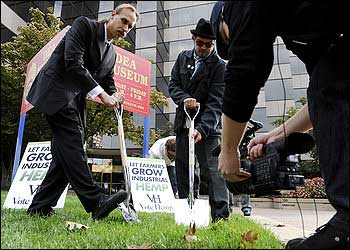
Planting hemp seeds on DEA's front lawn


David Bronner, left, joins Isaac Nichelson. (Photo By Jonathan Ernst For The Washington Post)

David Montgomery, in the Washington Post, has a delightful article about the symbolic planting that took place Tuesday at DEA headquarters by industrial hemp advocates.

The group included David Bronner of Dr. Bronner’s Magic Soaps, North Dakota farmer Wayne Hauge, and 73-year-old Will Allen, a farmer from Vermont. VoteHemp staff were there as well.

A total of six were arrested for trespassing and will have hearings this week. The expected fine is $240.

The DEA had nothing to say.

Phillip Smith has detailed coverage of this protest, including video, over at Stop the Drug War.
{source - Drug War Rant}

Monday, September 21, 2009

The Price of Pain - The real million dollar bust - The Gerry and Marilyn Greene Campbell Story

This is a follow up to a local story from August, Sophisticated hydroponic marijuana operation found and my own post on it. Thanks to Kim Davenport for this and giving us a perspective that the MSM rarely does.


The real million dollar bust

A CannonWire exclusive, as told by Barbara Broads.


It's the secret no one talks about.


“If you say it, everyone thinks you do it. That if you think it’s ok to legalize marijuana, you must want to buy marijuana. That’s just not so,” says Barbara Broads.

Barbara Broads, owner of Suprema Pizza in Woodbury, is Marilyn Greene Campbell’s daughter, Gerry Campbell’s stepdaughter. She stated that most people have been supportive of her mother and stepfather long before they knew the real story about the marijuana bust.

Even when they thought they were “just drug dealers,” because that’s only what the news has reported so far.

Anyone who has ever had or has a debilitating accident, disease or illness knows that the price of pain is high, both in money spent and lifetimes wasted, a thinly, shattered glass, often never recovered.

It’s the secret that no one really wants to talk about, that is, how your perspective changes when you or someone you love is in chronic pain. You will do nearly anything to make it go away.

That’s one of the many reasons hospice is so popular, because sometimes in the final part of the final days of life, your loved one is comforted with as much morphine as they can stand to ease their pain and suffering.


Shattered glass.

Gerry Campbell had a horrible accident in 1999. He ran off the Auburntown Road and his truck wrapped like a horseshoe around a tree. Responders thought he was dead when they arrived on the scene. He was immediately transported to a trauma unit. Usually if you’re there, you either die or spend a day or two at the most and transfer out, but he stayed ten days. Then he was moved to ICU for a couple of weeks, with a “turkey timer” stuck in his shaved head to monitor brain swelling. Then he moved down to a regular hospital room, then on to rehab for three months.

By all rights he should have died.

His is not an uncommon story, but what happened later, as you know, is.

When Gerry got out of the hospital, he was taking mega pain pills and his quality of life was poor. A lot of pain medications destroy the liver plus he had the additional complication of Hepatitis C, a liver disease.

If he had been taking the heavy pain drugs all the time compounding the liver issues with Hepatitis C, no question he would have died with liver failure years ago.

His liver is said to be 70% compromised. Of course when your liver goes, you’re dead.

So what does an old hippie in pain do?

The recreational user turned to what he knew would work, marijuana, to mitigate the pain and make it more bearable. He starts making his own medicine, which meant growing his own, for survival.

It was said he was able to cut down on some of the other harmful medication by substituting some of it with the marijuana.

To this day, he’s on prescription drugs, not morphine, but something similar, for the times when the pain is nearly unbearable. If he can get by with just medicating with marijuana, then that’s a bonus day for his liver.

Medicating illegally, of course, since that marijuana has not been approved for medical use in the state of Tennessee.


People know people.

Marilyn Greene has been a practicing midwife for over 30 years. A midwife and alternative healer, she found herself helping people when mainstream ways were often unsuccessful. She found Gerry Campbell, a kindred spirit, and they married.

Gerry’s wife Marilyn had a lot of contacts and they had a lot of friends. She ran upon people, and people who knew other people, that were dying of cancer or had other debilitating illnesses, or rather, they found her.

Next thing you know, they were growing enough for other people to use, too.

Barbara stated, “They were not selling the drugs to people who were sick, they were giving it away.”

Barbara stated, “I have an inkling that I know even back then, I knew who some of these people were, because there were people around when I was growing up that now I know had cancer or have died from cancer in recent years. I am sure it started with some of the people I knew growing up that were sick.”

“It’s a given that one cancer patient will know at least ten more cancer patients, and those people know people. All these people are desperate. They are all broke, and they are all hurting. And if they can get any relief, they’re going to take it. And if you’re dying, you really don’t even care what it is. Especially if it helps you live longer, and helps you not be as miserable.

“It mushrooms on you. You try and help one person, so they say, ‘you’re helping me and it’s helping, and I know you, and I know you’re having…AIDS problems or hepatitis problems, or whatever, maybe not the same problem as me…and I’m going to say, ‘I’ve got this friend, can you give them some too?’

“And they were giving it to these people.

“Even if the government’s paying, you’re paying, if you’re that sick.

“So here’s an alternative. It’s healthier, it can make you feel better, and someone is willing to give it to you.”


The cost of sickness.

Unless you live under a rock, you know that the health system needs overhauled, there’s no question. The question is how to get it done.

A medical emergency can often mean the loss of your home and your way of life because of a heartbeat that went astray.

People who once had nice home, cars, “stuff,” can lose it all in the blink of an eye when a catastrophic event occurs, in that the hospitals that helped you with their right hand come along with their left hand and take what you have when you can’t pay your bills. But the worst part of it, when your home, cars and things are gone, the illness and pain is sometimes still there.

“I can tell you. There’s a lot of people right here at home that are suffering now, and they’re messed up. It’s not like I can run down the road and find, (a.) someone who will sell it to me, and (b.) someone who would give it to me…more importantly.


Legality.

“About a week after it had happened, I talked to her [Marilyn], and she said that they had talked, I didn’t know this, about moving to California, because there you can grow it legally, he can smoke it there himself, but they decided that would defeat the purpose.

“Because in California, the sick people can get it. In Tennessee, these people who they are helping, cannot. So if they moved to California, it would be safer for them but they would be leaving everybody here high and dry, which is actually what just happened now.

And with it, chronic pain, which never sleeps or takes a vacation.

Cancer, AIDS, MS, ALS (Lou Gehrig's disease), and other chronic diseases where quality of life is sometimes questionable with mainstream medication find their quality of live improved in the alternative means of treatment, medical marijuana.


How it works.

“With cancer patients, it is a nausea issue and lack of appetite. You take the leaves, that may normally be thrown away, you dry them, pulverize them into a fine material, then mix with flour and water into a paste, bake it until it becomes “crackers.” What it does is quell the nausea and stimulate the appetite at the same time, and you don’t get the “high-high” that you get from smoking.

She stated that smoking it and eating it via the crackers are the two ways she knows about, and that is what she got from her two week medical marijuana crash education course.


What is was.

It was hydroponic marijuana, which reportedly looks different. The crop will be potent (if you started with good seeds) and clean.(1)

Hydroponics is an indoor growing method usually using an ebb/flow table which allows the grower to disperse water and fertilizer evenly throughout all the plants. On average, the type gown this way indoors has more dense buds of a higher THC rating because you can control everything from the light to the wind to the watering cycles.

THC is the chemical that makes you “high” and is concentrated in the buds of the plant.

There are male and female plants and indoor plants are usually started from clones (stem cuttings taken from the original and transplanted) which guarantee female plants that produce buds and also guarantees the strain.

On average, indoor plants grow shorter and bushier with dense buds, and outdoor plants grow taller and narrower with lighter fluffier buds. But it all depends on what type of marijuana you are growing and how you grow it. There are outdoor strains that are capable of yielding much more bud per plant than indoors, but indoors on average will give you a better harvest due to the control issue (light, water, etc.)

Also there are different varieties people have found that are best for different illnesses and not all varieties are the same.


The Million Dollar Bust.

When her mother teaches at Kaplan University, she stays in Nashville and plays free poker with some friends. So Barbara woke up to a phone call from the Davidson County Jail and said she thought, “I’ll be a son of a gun, I knew she would have too many beers at free poker one night.”

Barbara says her mother may have a beer or two on poker night, but she stays at a time share in Nashville, and she just knew she had been pulled over for a DUI. Maybe, she thought, she went over her limit and had three.

Marilyn tells her daughter she had gotten stopped with 4 oz. of marijuana. Barbara said, “You mean you don’t have DUI?” She asked her daughter to come and get her out. Barbara then called Gerry and she found that the TBI and Sheriff’s Department were already up at the house searching, which Gerry did give permission for them to do.

Barbara stated she didn’t have a clue as to the magnitude until she read the Courier report first, which stated it was a million dollar bust and 100+ plants. Broads stated, she didn’t have $150 three days ago, what is the deal? The next day she reads the Wire, and it says 273 plants, a million dollars, and some processed marijuana also.

The most amazing thing was the first night when she saw the picture in the Courier. She stated she “looked at the picture, and thought, oh my goodness, the whole underneath the house is hollow and it was huge, that it went on and on, and she thought, “How could I not have known?”

Barbara stated it was a masterful shot. When she went to look at the room the first time, it was a big letdown, because the room was probably 10x14 and not a mile long, like it looked in the photo.

She stated that in the corner there were some aluminum or other material that reflected light, so the person who took the photo positioned themselves in front of one table that had the tallest plants, with the reflection in the back that mirrored the plants. The plants are in a container, on a table and Captain Charlie Wilder was kneeling down. Those were the biggest plants in the photo. Her mom said the rest of the plants are just small ones that he’d just set out, and that you didn’t see a picture of those in the photo.

Also 8.7 pounds of the processed marijuana was leaves.

“It is what it is. They caught her in Davidson County selling a little bit, that’s when they couldn’t make the bills meet, and that wasn’t to one of the sick people. It was a stupid thing.

“If they’d just never done that.


So where’s the money?

Three days before the bust, Barbara asked her mother if she could borrow $150 and she didn’t have it.

“When the sheriff’s department and TBI made the bust, they kept asking Gerry, ‘Where’s the money?’ My stepdad says, ‘There’s a jar over there by the microwave, I think I’ve got about $20 in change, and I’ve got $80 or $100 right here in my money clip. That is the money. That’s all the money I have…”

“They have two mortgages on their house; she has a list of credit card debt that literally is a notebook page written out each month so she doesn’t forget anybody. At the first of the year when all that credit card stuff went around, they really started getting in a bind.

“Their newest car is a ’97, they live in a house they built themselves over several years that started out as one little room…well…two little rooms…and grew from there.

Barbara stated what happened is they were giving it away. She stated because that #1, they are hippies, and #2, they wanted to help people.

She stated they didn’t have any money, “Because they did, they wouldn’t have been ‘hocking stuff’ for lawyer money.”

“What they were doing is illegal. I’m not arguing that. It’s the same concept of trying to help someone else without needing some gratuity yourself.

“Some people can’t conceive it [that there’s no money there]. The cops really couldn’t believe it. I’ve had people say, ‘Have you been out there digging in the woods?’ Ok, first of all, they own 70 acres. If there was money there, I could dig the rest of my life and not find it.

“But I know how they lived, I know what they have, I know what their debts are, I’ve got boxes of bills that keep coming in to show it, I know they have three jobs between them, and can’t make ends meet. So I know they weren’t selling a bunch of dope. They don’t go on a lot of vacations; blow a lot of money, so they couldn’t have been having a ‘million dollar operation’ because they wouldn’t be $300,000 dollars in debt. They would have at least, even if you wanted to live off the radar, your stuff paid for. You wouldn’t have $100,000 in student loans and credit card debts. You might not live ‘real high on the hog,’ if you were smart, but you wouldn’t live that far in debt, that you couldn’t make the payments.

“The police really had a problem with that. I don’t think they do now.


Well-educated.

“It’s the funniest thing. They built the house from scratch, and when first they went there, it was all woods. They cut a mile right-of-way for the electric, by hand, by themselves. They milled the oak and made the paneling that’s on the inside walls of the house. They plumbed it, wired it, and built every part of that house. I didn’t get to see them build all of it (obviously) and by the time I saw the house, the room was already covered up. I have stood in kitchen, on the rug, on top of the trapdoor, about a thousand times in 14 years, with no clue.”

Marilyn has been a midwife and healer for over 30 years, has a master’s degree, and teaches at Kaplan University. Gerry is an e-Bay Power Seller and has lived in Cannon County his entire life.

She stated Gerry is a genus.

“The more people they found who were sick, that needed help, they wanted to help them and give them some, so the operation kept getting bigger.

She stated, “Gerry designed every aspect of it, and bought a little at a time, piece by piece, until he got it together. He got it up and running. It’s a newly efficient, maximized, expensive system, and they got it up and running.”

Gerry’s degree is in engineering. She stated that he could have sold the plans and a book and made money, and they wouldn’t be in debt.


What Barbara knew.

“It happened Tuesday morning, and Saturday morning, I went to a business here in town to get breakfast. I sat down with my food to eat, I heard the owner say to his employees, ‘Hey, did you guys hear about that big hydroponic bust in Liberty?’ I said, ‘Hey. That was my mom and stepdad.’ He ran over to my table and said, ‘What did you say?’ I said, ‘That was my mom and stepdad.’ He said, ‘Aren’t you embarrassed?’ I said, ‘No…I’m not on the front page.’

“I’m just amazed and blown away that we’ve made the news twice…Then someone saw me at the post office, and said, ‘I just want you to know I don’t think any less of you.’ Why would you think less of me? I didn’t do it! But that’s two people out of everyone I’ve talked to for three weeks. And about 97% didn’t know it was my mom until I said so.

“I’m not ashamed she’s my mom.

“Everybody thinks because it’s a small town, if you go to the bathroom, they know it before you flush.”

Barbara stated her whole life, she knew they smoked. She assumed there was some “out in the woods” for their own personal use. She never walked the woods because she didn’t care, and because they were adults.

At one time, she was mad at her stepdad and they fell out, so she moved out and got her own place.

After they built the new house, she stated when she came to visit, they would say they were going out to eat or whatever, and would ask her to leave. She honestly thought they thought she was going to steal something, and were still holding a grudge. She started not feeling welcome after a few years, even though she still went there some. What she didn’t understand then, but does now, that it was a small house, and if she’s watching TV or something, and if Gerry needed to go downstairs before the lights turned off, that he couldn’t. So they would tell her they were going to dinner so that she would leave. But they never did go out to dinner, it was just an excuse.

She found all that out a day or so before her mother turned herself in on Tuesday.

She stated that they have since had words about how she thought they didn’t trust her and told them that she had resented them treating her that way, because she got where she didn’t go for many family things, unless her brother came to visit.

Barbara’s now taking care of the house, the dogs, if something is sold, whatever. She states that anyone can put her on a polygraph, take a sample of her hair, because she doesn’t smoke, search her stuff, but she’s as clean as it can get.

That’s why they protected her and why they gave her their power of attorney. But for 14 years, she thought that they thought she was a thief that couldn’t be trusted in their house.

She stated that there are some things she knew and some things she didn’t but she’s had a crash course in the past few weeks. She stated that she guessed she thought that you smoked the whole plant, but learned since that’s not so. The buds are what the drug dealers want because it has the most THC (the chemical that makes you high).


Gerry’s arrested: Marilyn turns herself in.

Barbara stated that Tuesday, Gerry was in custody. Barbara and Marilyn were talking to a lawyer, and Marilyn was getting ready to turn herself in. Barbara stated that she called Captain Charlie Wilder of the Cannon County Sheriff’s Department and asked him if they were looking for her mom, because they didn’t know if they were or not, and he said they were.

So her lawyer and Marilyn then went to turn themselves in at the jail.

A few minutes later, Marilyn and her lawyer came back, and the lawyer asked, “Can you call up your friend again, tell him we went to the jail, and they didn’t know why we were there?”

When Barbara called, Charlie explained that one of the deputies was there but that one didn’t have the warrant. The one that had the warrant was on another call. So Marilyn went to the jail first and the jail had no idea they were there.


It’s a small town.

She had been friends with Charlie Wilder and Charlie had ordered pizzas there, but the rumor mill was saying he thought she was upset. So she was going to text him, as he had helped her with advice professionally and she considered him a friend.

She stated that before she could text, that Charlie called her, because the TBI had asked him to.

Among other things, she told him, “That’s your job, that’s what you get paid for and I’m paying you to do it [as a taxpayer].

Is she sad he caught her mom? Yes. Is she mad? No.

Most people have been very supportive of her.

She closed the pizza place for a little while and everybody thought she was on vacation. When she reopened, they asked where she had been, if she’d had a good time. Unfortunately, she spent more time there when she was closed, moving Gerry’s eBay store in and moving things around so she could get a handle on it.


On the run.

“Mom said they knew the risks, but they felt the risk was worth it. And now they’re on the run. Frankly I figure that they’ve watched too much TV.

When they were released, they went to visit Barbara’s brother and sister, taking a trek to Gatlinburg then around to Las Vegas.

“When they left here, they had their car, which books for like $2,000, and $1,500. They also had some lighters they could pawn if they ran out of money before they got home, five or six of them, from his eBay store.”

(He traded in lighters, she states she is doing her best maintaining his eBay listings, and right now has about 500 active listings. She stays Gerry made around $30,000 last year from his eBay store. He buys and sells antique lighters, ashtrays, and art deco.)

She stated, “They did not show up on the court date and it is what it is.

“Charlie called me and he said, ‘The TBI is afraid that they’re getting ready to run.’ And I said, ‘Charlie, when I called John and he told me that they didn’t show up for court, I really didn’t figure ‘getting ready’ even figures in anymore.’ When they didn’t show up for court, I knew right then they made a bad decision not to come home from Vegas.

“I was already getting a clue beforehand because they hadn’t talked to anybody in a week or a week and a half since they left my sister’s. It doesn’t take a week and a half to drive back from Vegas. They threw away the cell phones. I’m already getting a clue that this isn’t good. But I was still giving them the benefit of a doubt until the court date. So the court date comes and they’re not here, they’re probably not ‘getting ready’ to do anything, you know.

“And then they’re like, ‘Well, if anybody can contact them, he’s got to turn himself in.’


Guilt by association.

“I was always brought up to say the pledge, I believe in this country, I love my friend Jennifer for defending us, I love our soldiers…I have a friend that’s a veteran, and he asked, ‘how did you come by these ideas?’ Because my mom is about as hippie as you can get and they don’t think like that. And I said, ‘I don’t know.’ But somewhere, I’ve absorbed something else and I love this country.

“I was also raised to believe that you were innocent until proven guilty. And that the constitution really did protect your rights.

“But let me tell you, that’s a lie. A flat out lie. I am a registered Democrat, I vote Independent, and after yesterday, I’m pretty sure I’ll be a solid Republican from now on.

“I found out yesterday, that even though there’s not a whisper of a hint of suspicion against me for anything, they now have the power to tap my phones, check my mail, watch my movements, listen to every noise I make in my house that they want to.

“And I’m not under any suspicion of anything.

“Just in case that my mom may call me. It hasn’t happened, and I haven’t done anything, but they can trample my rights into the mud and there’s not a damn thing I can do about it. I’ve been almost numb trying to keep up the business, and my farm, and subbing [substitute teaching], taking care of their house, and taking care of the eBay store.

“Yesterday when I found that out, that’s the first raw emotion I’ve actually had, in probably two weeks.

“This is not that I’m going to make a drug deal or launder some money in the business…it's the principle. If I need to doctor my horse, it’s none of their business. If I want to talk to Michael, it’s none of their business. And this is going to go on indefinitely. It’s not like that they can tap my phones for a day or a week, they can tap them until my mom is found. If she’s not found, they can be tapping my phones forever.

“And you are guilty by association whether you have done anything or not, and once that happens, you don’t have rights anymore, apparently. And that blows me away. It’s one thing if you tell me I was under suspicion, or I was accused of something, or anything.

“But if you tell me I have done nothing, and you can trample my rights, right into the dirt? I have no rights. Basically, they can drive up beside my car and monitor my cell phone communications, they can tap Suprema’s phone, or the house phone.

Let me tell you, once you start thinking that, your phone starts making weird noises. Then you just don’t know. Then you have to think, why is everybody who’s called today, why are they all sounding like they’re in a well?

“I literally called my sister up when I was out yesterday. I said, ‘Look, don’t have any phone sex, because your twosome will be a threesome. Because anything you say is subject to be recorded. ‘

“So now my sister and I have determined that we’re going to start saying random things into the phone. You’ve got to have some humor somewhere.


Misinformation

“When generally honest people…get caught…they don’t have a clue how the system works.

“First of all, they’re hippies. It’s automatically in their mind; big brother is out to get them. I will point out that my mom’s big brother got elected president…I’m not sure how big brother is out to get them because her big brother is running the country.

“All the information that my mom and stepdad got from, I don’t know where, was wrong…they had in their head when they left on vacation, and if we could have talked to this man before they left, we would not be in the position that we are in today.

“Mom and Gerry thought their lawyer told them it could go Federal. That scared them because that would mean Federal prison. Then someone, maybe they watched too much TV…because they had some plants, and because they had some legally bought registered guns, some were antiques…that the Fed’s were going to come in the middle of the night, and this was after they had already bonded out. His bond was $1,300 and hers was $2,600.

“Hard time criminals here. Neither one of them had any record; Gerry had two DUI’s I think. My mom had nothing except for speeding tickets, most on her way delivering babies. That’s it. So this million dollar operation, $3,900 total bond for both of them. If this is really this big, I don’t see you bonding out for $3,900.

“They also thought that the Feds wouldn’t wait for the hearing, that they could come in the middle of the night, they would arrest them, take them to prison, and they would not get bond and would have to stay in prison until the trial.

“They thought they were automatically going to lose because they’re fighting the whole United States government who has an unlimited budget, and they’re broke. They would never get out of prison, not ever going to see each other or be able to talk to each other again.

“Part of this was hype because when Gerry was arrested that morning, Tuesday morning, Mom turned herself in Tuesday afternoon. They didn’t bond out for three days, I think. Mom said every time somebody opened the door, one of the officers, any of the officers, she said, ‘Please tell my husband that I love him. She told every single person.

“The morning of the hearing, Gerry called and left a message on Mom’s cell phone, ‘Would she please go get his prescription medicine.’ He had no idea she had been arrested. So, that panicked both of them.

“And they’re just in the county jail, and no one would even tell him that she loved him.

“I know they probably have policies on that, but you’re dealing with a 59 year old and a 53 year old who have never done anything and are now in this position and he didn’t even know that she was arrested.

“So now someone’s telling them that they’re going to the Federal pen and have to stay there until the trial, whenever that he is, and they’re going to lose, because that’s the government. You know, big brother is out to get them.

“That was the maximum sentence because the quantity, or something, I’m not exactly sure.

“The drug cops said the guns weren’t used in the commission of marijuana so they did not count.

“The thing is I found out yesterday…they were under the impression just because they had the guns, and it was over 100 plants, automatically that made it mandatory sentencing, twenty years in prison, and Gerry’s going to die in prison. This is what they left on vacation believing. That at any second, the feds were going to come, take them out of their house, take them to prison, no bond until the date, they’re going to lose, mandatory twenty years, Gerry’s going to die, and they’re never going to see each other again.

“That’s when they decided they’re going to visit my brother my sisters, and that way, at least the fed’s couldn’t get them until they came back for court. They went up to Gatlinburg first then to see my brother.

“And they were so paranoid at this point that when they left, the day after they bonded out, they left me their cell phones. They thought they would triangulate their cell phone coordinates and swoop them up from vacation when they were legally bonded and take them to prison. They were already in this mindset of full blown panic.

“And I don’t know where they were getting all this information because yesterday, when I met this guy who is our kinfolk, and told him what was going on, he said, ‘They’re nothing. We’re looking for pipelines. We’re looking for the guys that are bringing it up in eighteen wheelers and sending it on. This was in the basement. And there’s no pipeline. Once they realize there was no money, and no pipeline, and no big thing, they cease to exist. We send out a thousand BOLOS a day and this is nothing.

A knowledgeable friend of Barbara’s said the Feds don’t routinely kick in doors unless they think that they’re going to have a gunfight. What they usually do is call your lawyer and tell them to have you at a certain place at a certain time.

Everything they were upset about was wrong. Unfortunately they were already gone when everyone finally remembered there were cousins and others who would actually know instead of listening to all the misinformation.

Actually, according to Barbara, Gerry’s charge would be misdemeanor manufacturing and he would probably have gotten probation. Most likely he would not have even gone to jail. She said they had a great lawyer but they didn’t communicate, because she felt they couldn’t calm down enough to talk to her.

Barbara says Gerry’s first cousin is a drug cop, officer, detective, and has been doing that his whole career and has even dealt with the cartel when he was in the military, and his wife is a bail bondsman.


Free at Last, the Friendly Bounty Hunter Dog

It seems you are given a list of bonding companies when you’re arrested. Marilyn ran her finger down the list given to her at the Davidson County jail and chose one because she liked the name. It was called, “Free at Last.”

Barbara’s sister called the bail bondsman, at Free At Last, who has been nice up to this point, until he found out Gerry and Marilyn didn’t show, then his tone changed.

“My sister calls and tells them within a few hours, ‘This is what happened, they have not shown up.’ He said, ‘You got 48 hours to get my money, $46,500 in my office, in full, or I will hunt your parents down, I don’t care if I have to go to Cuba, Tahiti, wherever, I don’t care if I have to spend $300,000, it’s the principle, I do what it takes and then I’ll go after your little brother, too.

“My sister calls me, frantic, throwing up, in tears. And here we’re thinking, we called him, just a few hours after court. We’re saying, ‘Hey, they’ve done this, but we’re going to stand behind this.’ Because my little brother’s not going to lose his house. And this is the response we got from him.

Barbara’s brother put his house up on the bond, her sister paid more than half the lawyer, John and Marion, Gerry’s dad and mom paid the 10%, and Barbara’s dealing with their stuff on the ground.

Gerry’s cousin who is a bail bondsman, called the guy at Free At Last, just to talk with him. He stated that if he didn’t have his money in 48 hours, he’s going to go over in the middle of the night, kick their doors in, and seize their stuff, and then he’s going to hunt Marilyn and Gerry down if it takes him $500,000, and he didn’t care where he had to go to do it.

They plan on filing a formal complaint against him.

They found out later, that by law , they have eight months to pay the bond, so that means they have eight months to get them to come home, not two days like he said. Also whether they come home in two months or take the full time, it doesn’t tack on any more time.

Barbara states that if the bounty hunters finds them, at this point in time she doesn’t care how they come back just as long as they do. She just wants them home.


Just come home.

She’s worried about them because she thinks they didn’t think it though. You’ve got to have money when you’re running and you can’t run with a bad disease like Gerry has.

Barbara has found out though the knowledgeable cousins, even with all the charges, with even the felony (it was then a felony when they didn’t show up for court), that it’s all related to the same reason, that this is the first time they’ve ever done anything, and they just panicked.

She wants them to know it’s not what they thought it was and it’s going to be ok.

And she wants them to just come home.


********************

Thanks to Barbara Broads for trusting me to tell the story.

Let it be noted that the writer of this article has never partaken of marijuana in any form, medical or otherwise, and never even smoked a cigarette, but understands chronic pain and is so very thankful to be, at the present time, free from it.

“But for the grace of God, go I.”

-Kim Davenport

Source: Cannon Wire

Thursday, September 3, 2009

The War on Drugs Goes Too Far

Another tale from the "WTF" files.....

Handicapped man's Wheelchair Seized Over Medical Marijuana
CANNABIS CULTURE - A Canadian care home resident with full body paralysis was confined to his bed against his will after his wheelchair was seized by caregivers - all because he smokes medical marijuana to relieve his Multiple Sclerosis.

CHBC news reported yesterday that Nyle Nagy, a Kelowna, British Columbia man who lives at the Brookhaven care home, was forcefully removed from his wheelchair and put in bed for a week after manager Adrien Vaughan objected to his legal use of medical marijuana.

"She sent two men over here to take my wheelchair and tell me that I've got to stay in this chair for seven days, as a punishment", Nagy told the TV crew.

"To get rid of my pain and my spasms, that's the only two reasons I smoke it" said Nagy, who has a license from the Canadian government to smoke marijuana.

The news comes in the wake of a similar abuse case in Vancouver where a diabetic, double-amputee woman died after being evicted for legally smoking medical marijuana.


Source: Cannabis Culture

Thursday, August 27, 2009

Just trying to make a living

Some estimates are that in this county the unemployment/underemployment rate is over 25%. That leads some folks to go outside the law in order to survive.

The crime rate here is up and the police should be using their time to catch the real criminals. Until we address the legalization of marijuana, these photos ops and local news features will continue with no noticeable improvement in the lives of the county population.

As usual, the Nashville media is hyping the value of this crop at $2 million. Wow! Become a millionaire with only a basement, some equipment and a few seeds. Just don't get caught.
http://www.cannoncourier.com/files/image/article/full_405.jpg

Sophisticated hydroponic marijuana operation found
A local husband and wife team were arrested Tuesday when a sophisticated hydroponic marijuana operation worth over a million dollars was found in the Liberty area of Cannon County.

Sheriff Billy Nichols along with the Cannon County Sheriff’s Department cooperated with the TBI in arresting the couple and confiscating the equipment, marijuana and 273 marijuana plants.

The TBI came to the Cannon County Sheriff’s Department stating they had an active marijuana drug case against Marilyn Greene, AKA Marilyn Campbell and requested assistance to locate the home on Bony Ridge Road and acquire a consent to search.

When officers arrived at the home, Gerry Lynn Campbell met officers at the door and after some conversation, produced a small amount of marijuana stating it was for personal use.

However, Detective Charlie Wilder noticed several stems that had been stripped of marijuana in the kitchen area. After that discovery, officers asked and were given permission to search the rest of the home and property.

Found in the bedroom was an ashtray with several marijuana roaches, glass pipe and rolling papers. In another room was four box trays with marijuana laid out to dry. In the kitchen was a set of digital scales along with a plastic bucket that contained a large amount of processed marijuana buds.

As the group were logging the items and photographing them, Deputy Fann noticed a trap door under a rug in the kitchen. He raised the door to reveal a set of steps leading under the house to the basement where they found a sophisticated hydroponic marijuana operation with 273 plants in various stages of growth.

The room had all the lights and starters, water pumps and a reservoir, fertilizers, written instructions and other paraphernalia needed to carry out the operation. There were three hydroponic tables in the basement, two were active and the other was ready to be set up. A freezer contained a large bag of processed marijuana.

Officers disassembled the operation and transported it to the evidence storage facility. The marijuana was bagged and transported to the TBI Crime Lab. {More}


Also see: Another Arrest Made In Alleged Underground Marijuana Growing

Wednesday, August 5, 2009

How Will the Feds React to New State's Rights Industrial Hemp Growing Laws?

They are probably not very happy about it and look for them to try and stop it. It could cut into the profits of some mega-corporations and as we all know, hemp is an environmentally friendly crop. Can't have that, can we?
http://i676.photobucket.com/albums/vv126/kennyrk2/canadahemp.jpg?t=1249474423
Not just for Canadian farmers anymore?

Oregon Hemp Farming Bill Becomes Law

New State Program for Hemp Farmers to be Established

August 4, 2009

SALEM, OR — Vote Hemp, the leading grassroots advocacy organization working to give back farmers the right to grow industrial hemp (the oilseed and fiber varieties of Cannabis), enthusiastically supports the decision of Oregon Governor Ted Kulongoski to sign SB 676 into law today. The bill, which passed the House by a vote of 46 to 11 and the Senate by a vote of 27 to 2, permits the production, trade and possession of industrial hemp commodities and products. With the Governor's signature, it now makes a politically bold commitment to develop hemp in a state whose slogan is "Oregon - We Love Dreamers."

"I am glad that Oregon has joined the other states that have agreed that American farmers should have the right to re-introduce industrial hemp as an agricultural crop," says SB 676 sponsor, Sen. Floyd Prozanski. "By signing SB 676 into law, which passed the Oregon Legislature with strong bi-partisan support, Governor Kulongoski has taken a proactive position allowing our farmers the right to grow industrial hemp, to provide American manufacturers with domestically-grown hemp, and to profit from that effort." The new law sets up a state-regulated program for farmers to grow industrial hemp which is used in a wide variety of products, including nutritious foods, cosmetics, body care, clothing, tree-free paper, auto parts, building materials, fuels and much more. Learn more about hemp at www.VoteHemp.com.

"Oregon's federal delegation can now take this law to the U.S. Congress and call for a fix to this problem, so American companies will no longer need to import hemp and American farmers will no longer be denied a profitable new crop," comments Vote Hemp Director, Patrick Goggin. "Under current federal policy, industrial hemp can be imported, but it cannot be grown by American farmers. Hemp is an environmentally-friendly crop that has not been grown commercially in the U.S. for over fifty years because of a politicized and misguided interpretation of the nation's drug laws by the Drug Enforcement Administration (DEA). While a new federal bill in Congress, HR 1866, is a welcome step, the hemp industry is hopeful that the Obama administration will recognize hemp's myriad benefits to farmers, businesses and the environment," adds Goggin.

Many businesses in Oregon manufacture, market and sell hemp products, including Living Harvest, The Merry Hempsters, Wilderness Poets, Earthbound Creations, Sweetgrass Natural Fibers, Sympatico Clothing, Mama's Herbal Soaps and Hempire. Living Harvest of Portland was recently ranked the third-fastest-growing company in Oregon, as awarded by The Portland Business Journal's "Fastest-Growing Private 100 Companies" annual award. "We are looking forward to the opportunity to invest in hemp processing and production locally," says Hans Fastre, CEO of Living Harvest. "This new law represents another step towards heightening the hemp industry's profile within mainstream America and making hemp products more accessible to businesses and consumers."

These Oregon-based companies have been on the leading edge of the growing hemp food and body care markets, which are currently estimated by the Hemp Industries Association (HIA) to be $113 million in North American annual retail sales. The HIA estimates the 2008 annual retail sales of all hemp products in North America to be about $360 million. By allowing U.S. farmers to once again grow hemp, legislators can clear the way for a "New Billion-Dollar Crop."

Hemp Farming Gains Support from More State Governments and Law Enforcement

According to the Illinois Valley News, Josephine County Sheriff Gil Gilbertson said that he supports the legalization of industrial hemp. "I think it's a good idea," Gilbertson said in the article which appeared on July 29. "I think it's a viable crop, and the entire county could benefit from it."

On June 9, with little fanfare, Maine Governor John Baldacci signed the Maine hemp farming bill, LD 1159, into law. Maine's House had previously passed the bill without objection, and the Senate later passed it by a strong vote of 25 to 10. The bill establishes a licensing regime for farming industrial hemp, although the licensing is contingent upon action by the federal government. Maine had previously passed a study bill that also defined industrial hemp. Like North Dakota, the new law in Oregon does not require a federal permit to grow industrial hemp.

During the 2009 legislative session, Maine, Montana, New Mexico, North Dakota and Vermont all passed pro-hemp laws, resolutions or memorials. Sixteen states have passed pro-hemp legislation to date, and eight states (Hawaii, Kentucky, Maine, Maryland, Montana, North Dakota, Vermont and West Virginia) have removed barriers to its production or research. Like North Dakota, where farmers are in a federal court battle over their rights to grow hemp under state law without fear of federal prosecution, the new law in Oregon does not require a federal DEA permit to grow hemp.

# # #

Vote Hemp is a national, single-issue, nonprofit organization dedicated to the acceptance of and free market for low-THC industrial hemp and to changes in current law to allow U.S. farmers to once again grow this agricultural crop. More information about hemp legislation and the crop's many uses may be found at www.VoteHemp.com or www.HempIndustries.org.
source: Vote Hemp

Tuesday, June 30, 2009

1,2,3.....What are we fighting for

Don't ask me I don't give a damn
Next stop is Tajikistan
paraphrased from Country Joe McDonald

Drug flow means big bucks for the big banks and for the CIA.


U.S. - built bridge is windfall - for illegal Afghan drug trade

Gateway for Afghan opium

By Tom Lasseter | McClatchy Newspapers

NIZHNY PANJ, Tajikistan — In August 2007, the presidents of Afghanistan and Tajikistan walked side by side with the U.S. commerce secretary across a new $37 million concrete bridge that the Army Corps of Engineers designed to link two of Central Asia’s poorest countries.

Dressed in a gray suit with an American flag pin in his lapel, then-Commerce Secretary Carlos Gutierrez said the modest two-lane span that U.S. taxpayers paid for would be “a critical transit route for trade and commerce” between Afghanistan and Tajikistan.

Today, the bridge across the muddy waters of the Panj River is carrying much more than vegetables and timber: It’s paved the way for drug traffickers to transport larger loads of Afghan heroin and opium to Central Asia and beyond to Russia and Western Europe.

Standing near his truck in a dusty patch on the Afghan side of the river, Yar Mohammed said it was easy to drive drugs past the Afghan and Tajik border guards.

“It’s an issue of money,” Mohammed said, to the nods and grins of the small group of truckers gathered around him near the bridge at Nizhny Panj. “If you give them money, you can do whatever you want.”

The roots of the global drug trade are often a murky tangle of poverty, addiction, violence and corruption. However, it’s clear why the dirt-poor former Soviet Central Asian republic of Tajikistan is on the verge of becoming a narco-state.

After the U.S.-led invasion of Afghanistan in 2001, the United States and other Western powers looked the other way as opium and heroin production surged to record levels, making Afghanistan by far the world’s biggest producer.

Much of the ballooning supply of drugs shipped across Afghanistan’s northern border, up to one-fifth of the country’s output, has traveled to and through Tajikistan. The opium and heroin funded rampant corruption in Tajikistan and turned the country, still hobbled by five years of civil war in the 1990s, into what at times seems like one big drug-trafficking organization.

Every day last year — extrapolating from United Nations estimates — an average of more than 4 metric tons of opium, which can be made into some 1,320 pounds of heroin, moved on the northern route. Put another way, the equivalent of nearly 6 million doses of pure heroin — at 100 milligrams each — is carried across the northern Afghan border each day.

After it’s cut with other substances and sold on the street corners and in the apartment stairwells of Russia and Western Europe, the main retail markets for Central Asian heroin, that could produce at least 12 million doses.

Nevertheless, it’s clear even to a casual visitor at the bridge that neither the Afghan or the Tajik border guards have much interest in curbing, or even inspecting, the exports that pass in front of them.

In fact, as the Afghan drug supply has grown, Tajik seizures have fallen. In 2004, Afghanistan produced 4,200 metric tons of opium, and some 5 metric tons of heroin or its equivalent in opium were seized in Tajikistan, according to U.N. figures. Last year, with Afghan cultivation rising to 7,700 metric tons of opium, Tajik authorities seized less than 2 metric tons of heroin.

Although the United States wields enormous influence in both countries, their drug problems have taken a back seat to the war against the Taliban. Until the past year, Afghanistan’s growing drug production was at best a midlevel priority for Washington, and the U.S. hasn’t pressed Tajik President Emomali Rahmon to rein in his country’s drug trafficking, Western officials said. Nor, they said, has any other Western government with troops in Afghanistan.

All along the Afghan-Tajik border, smugglers for years have thrown sacks of heroin over the Panj River, waded across when the water is low, set up flotillas of car tires and used small ferries or footbridges.

The U.S.-financed bridge has made drug trafficking even easier, truck driver Mohammed said with a toothy smile: “You load the truck with drugs.”

The ferry that used to operate at Nizhny Panj carried about 40 trucks a day. The bridge can carry 1,000 vehicles daily.

Organized crime groups now are focusing on using official checkpoints to move their drugs, a senior official at the Tajik State Committee for National Security said, speaking to a recent meeting of Central Asian counter-narcotics officers.

“Especially through the Tajik-Afghan bridge on the Panj River,” Davlat Zarifov said.

Zarifov apparently didn’t know that a reporter was present, and he declined further comment and quickly walked away.

To try to get the Tajik government’s side of the story, a McClatchy reporter approached Sherali Mirzo, the official in charge of the country’s border guards, a man with a full mustache and medals across his uniformed chest. Mirzo said he didn’t talk to the media.

Rustam Nazarov, the director of the country’s drug control agency, said in a brief interview that the declining heroin and opium seizures suggested that there was less trafficking of those drugs through Tajikistan, an analysis that the facts on the ground would seem to contradict.

Nazarov, however, did allow that, “There is corruption in Tajikistan; no one denies that. Unfortunately, we have some civil servants who are corrupt.”

A few days later at the Afghan-Tajik border, as the sun began to dip below a horizon framed by jagged mountains, Mohammed Zahir, an Afghan truck driver, gave a simple explanation for how drugs get across the bridge.

“People involved with the drug business know the guards,” Zahir said. “Before sending their drugs across, they pay them money.”

A second driver, Qand Agha, chimed in: “If high officials on the border weren’t involved, then people like me couldn’t take drugs into their country.”

Down the road, a line of trucks was crossing the bridge.

‘DENGI, DENGI’

Sitting in a $40,000 SUV with soft leather seats and a dark orange paint job, a man named Negmatullo hitched up his shirtsleeve to show the sore on his arm from the heroin he’d been shooting up. He fiddled with his designer sunglasses, absentmindedly brushed his hair and said in a junkie’s mumble that, “If you pay someone at the border, you can bring drugs up.”

Negmatullo, a thin man with dirty blond hair, had just come out of a drug treatment clinic in the town of Kurgan-Tyube, a halfway point between the border and the Tajik capital of Dushanbe. He asked that his last name not be used for his own security.

When Negmatullo was asked why guards and other Tajik law-enforcement officials would be susceptible to corruption, he rubbed his fingers together and muttered “dengi, dengi,” Russian for “money, money.”

The car’s license plate flashed by as Negmatullo pulled away; it was number 7777, a calling card of those connected to the president’s inner circle.

The spoils of the drug trade are as obvious as the shiny new BMWs speeding down the dusty roads that cut from south to north across the steppes of Tajikistan, passing hunched old men who tend the cotton fields with hoes. It’s an ancient setting: Alexander the Great and his men conquered parts of the territory in the fourth century B.C, and they’re said to have crossed the Panj River by floating on leather hides.

These days, in a nation where some 50 percent of the population makes less than $41 a month, there’s a steady stream of new Mercedes and Lexus sedans, not only in Dushanbe, but also in the hamlets that dot the way to the Afghan border.

Locals say the cars often are given in trade for loads of heroin shipped north to the Russian border. The stuff is easy to get.

“You can just take two bags over your back, walk across the Panj and bring them back filled with heroin. It’s no problem,” said Vazir, a Tajik who was released from a Russian prison last February after he was caught trying to take 600 grams of heroin through a Moscow airport. During an interview in Dushanbe, he asked that his last name not be used because he feared retribution.

Vazir continued: “You can give your bag of heroin to one of the guards, and he will carry it across for you.”

‘A CULTURE OF IMPUNITY’

The supply chain appears to reach far beyond hustlers such as Vazir. Many Western officials and Tajik observers suspect that the Rahmon government controls the drug trade.

“I don’t know if the president is involved personally, but he gives the percentages to different groups for what they can do,” said one Western diplomat in Dushanbe, who like others spoke only on the condition of anonymity because of the sensitivity of criticizing the regime. “Just go to the airport. There are bags of heroin going through unchecked. . . . People are pretty open about it. There’s more and more a culture of impunity.”

After the Soviet Union fell in 1991, Russian troops continued to patrol the Tajik border. They withdrew from the area in 2005 after the Tajik government demanded that they leave — though it allowed them to stay in other parts of the country — asserting that as a sovereign nation Tajikistan was capable of securing its own frontiers.

An assortment of local conscripts replaced the relatively professional Russian contingent, which trained and financed the Tajik officer corps.

“You have conscripts earning maybe $3 a month stretched out over 1,344 kilometers of border” — 835 miles — said another Western diplomat in Dushanbe, discussing the problem of drug dealers paying border guards to look the other way. “It’s obvious that if you need to eat, corruption is an option.”

Some Russian and Western officials said privately that the Tajik government wanted the Russians out of the way to ensure a larger supply of opium and heroin.

It was a move designed to gain “hold of a bigger part of the drug trade,” one Western diplomat in Dushanbe said.

“Frankly speaking, there were forces in the government of Tajikistan who wanted to replace the Russian troops with Tajik troops to allow more holes in the border,” said a Russian official in Moscow who travels regularly to Tajikistan and has high-level contact with the Tajik government. “It was to make the penetration of drugs easier.”

The State Committee for National Security, Tajikistan’s version of the KGB, took control of border enforcement in 2007 and almost immediately barred the country’s Interior Ministry and drug control agency from access to the border region.

‘THERE IS ALWAYS GOING TO BE A TRADEOFF’

When a McClatchy reporter drove to the border at Nizhny Panj to do interviews, troops turned him back because he didn’t have official permission. A border guard supervisor in plainclothes pulled the reporter’s driver aside and suggested in a menacing tone that the driver was a spy. The Tajik government later denied McClatchy permission to visit the southern border.

The reporter resorted to crossing the bridge into Afghanistan with a routine visa, and he saw no evidence that Afghan or Tajik officials were inspecting trucks for contraband.

Despite the public nature of the drug trade and related corruption in Tajikistan, however, the West has done relatively little to pressure President Rahmon.

Some Western officials acknowledge that it’s the result of a political tradeoff: No one wants to risk alienating Rahmon on the issue of drug corruption because his authoritarian regime’s cooperation is important for preventing Islamic militants from using the Tajik-Afghan border as a sanctuary.

“The Americans want to have a logistics base here, so do you think they’re going to pressure the government about corruption?” said William Lawrence, a chief adviser for a U.N. Afghan border-management program based in Dushanbe. “The answer is no.”

The U.S. Embassy in Dushanbe declined to comment, but a State Department official said that such balancing acts were common.

“There is always going to be a tradeoff based on different foreign-policy objectives, different security objectives, the tolerance for different types of corruption, different levels of corruption,” said the official, who spoke on the condition of anonymity because of diplomatic protocol. “I don’t think the situation in Tajikistan, frankly, is that much different than the rest of Central Asia in terms of these types of tradeoffs.”

A second Western diplomat in Dushanbe was more blunt about Western governments ignoring reports on Tajikistan’s official complicity in drug corruption.

“We send reports every month to our capitals, very negative, but they don’t (care),” said the diplomat, whose country has troops in Afghanistan. “Because it’s a so-called stable country leading to Afghanistan, we accept it.”

The diplomat said that his country had funded projects to help train and equip the Tajiks to deal with the drug problem. The United States and other Western nations have done the same.

This month, for example, the U.S. ambassador to Tajikistan broke ground on a $2.5 million project to overhaul the border guard training academy in Dushanbe. The American Embassy said in a recent news release that it had implemented more than $37.5 million of initiatives to help Tajik law enforcement since 1992.

However, the second Western diplomat said, there isn’t much arm-twisting to make sure the Tajik government cracks down.

“We don’t dare to say to the president, ‘We give you money for anti-corruption but the first thing you see on the streets is these police taking bribes,’ ” the diplomat said. “Nobody says, ‘We’ll give you money for border security, but in three years we want to see a reduction in drugs.’ “ {source}

Post by way of There are no sunglasses

Related:

Flood of Afghan heroin fuels drug plague in Russia

Afghanistan: Drug Addiction Lucrative for Neolib Banksters, CIA

CIA, Drugs and the US Economy - video

CIA Drug Trafficking and remembering Gary Webb

Afghanistan, American Drug Colony

CIA: Secret Operations, Drug Money

The CIA and Drugs